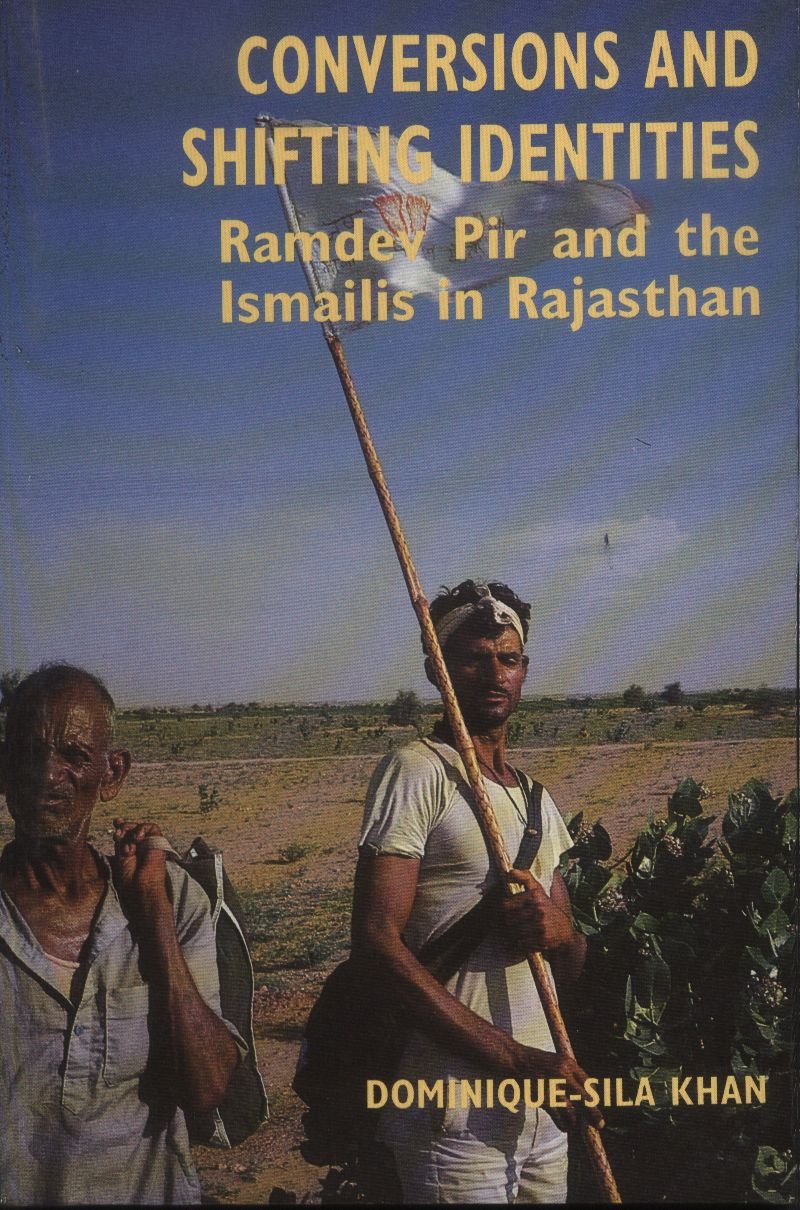
Conversions and Shifting Identities: Ramdev Pir and the Ismailies in Rajasthan
Conversions and Shifting Identities: Ramdev Pir and the Ismailies in Rajasthan
Hardcover
Couldn't load pickup availability
DETAILS :
- Author : Dominique-Sila Khan
- Publisher : Manohar Publishers & Distributors
- Publication date : 1 September 1997
- Language : English
- Hardcover : 294 pages
- ISBN-10 : 8173041814
- ISBN-13 : 978-8173041815
- Item Weight : 750 g
ABOUT THE BOOK
Conversions and Shifting Identities: Ramdev Pir and the Ismailies in Rajasthan is a groundbreaking work of historical and anthropological research by Dominique-Sila Khan. The book explores the fascinating and often "hidden" history of the cult of Ramdev Pir, a popular folk deity in Rajasthan and Gujarat. While he is widely worshipped today as a Hindu "avatar" of Vishnu or Krishna, Khan reveals a much more complex reality: the historical links between the Ramdev tradition and the Nizari Ismaili (a branch of Shia Islam) missionary activities in medieval India.
The book delves into the concept of "liminal identities"—communities and figures that exist on the boundaries between Hinduism and Islam. Khan meticulously traces how Islamic symbols, rituals, and terminology were gradually "Hinduized" over centuries, a process she terms "Vaisnavization." This work is essential for understanding the fluid nature of religious identity in South Asia before the rigid categorizations of the colonial era took hold. It challenges the "clash of civilizations" narrative by highlighting a shared, syncretic heritage that remains visible in the local songs (bhajans), shrines, and oral traditions of the region.
ABOUT THE AUTHOR
Dominique-Sila Khan (1947–2004) was a brilliant French-born researcher and a leading authority on the syncretic religious traditions of Rajasthan. She spent decades living in India, specializing in the intersection of Sufism, Ismailism, and Hindu Bhakti movements. Her work was celebrated for its bold refusal to accept simplified sectarian labels and for its deep empathy toward "marginalized" histories. Beyond this seminal work, she authored several books on the Satpanth tradition and the shared sacred spaces of the subcontinent. Her legacy continues to influence scholars of South Asian religion and sociology.
Share