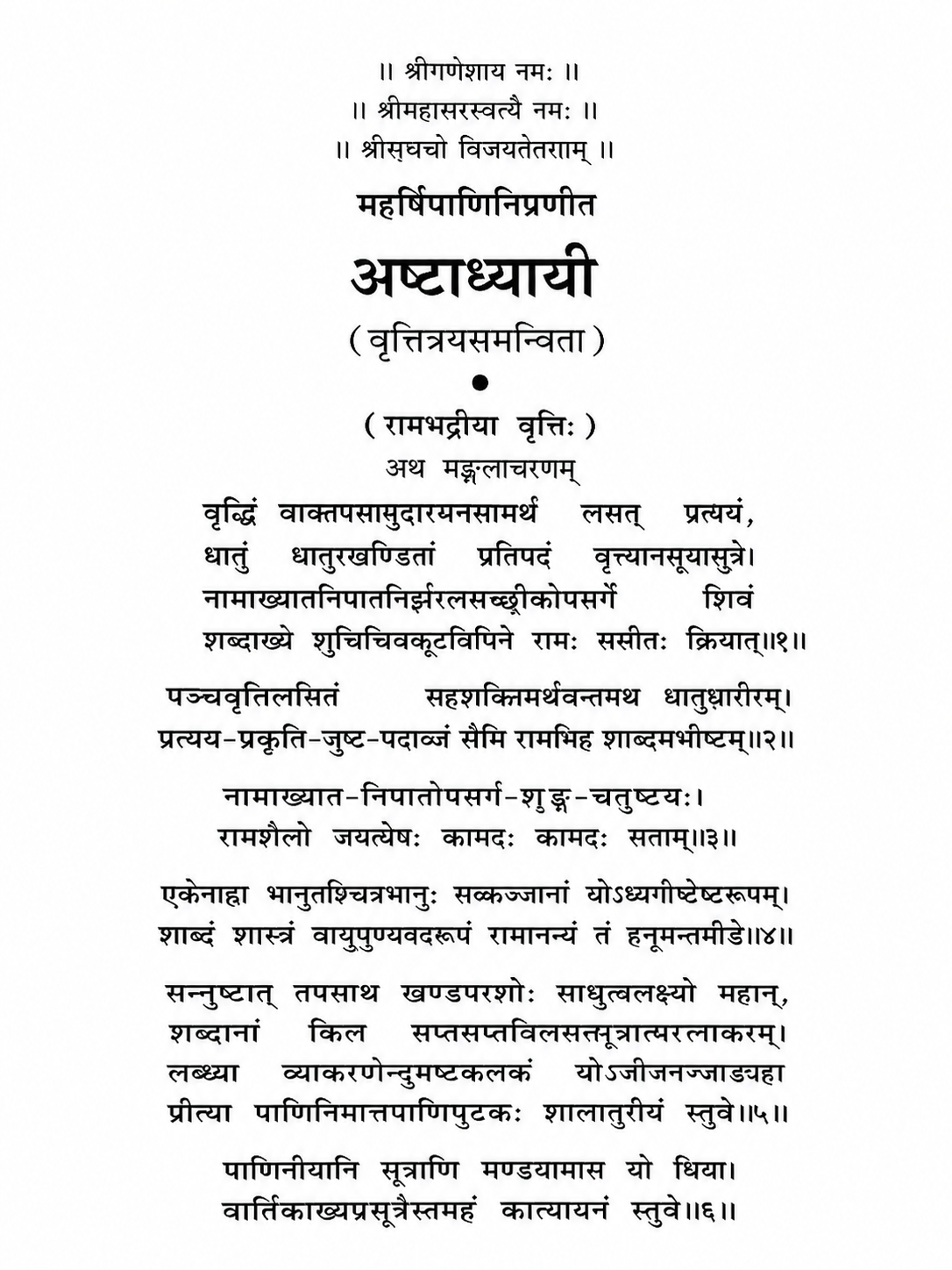
महर्षिपाणिनिप्रणीता अष्टाध्यायी: Ashtadhyayi Composed by Maharishi Panini (Set of 8 Volumes)
महर्षिपाणिनिप्रणीता अष्टाध्यायी: Ashtadhyayi Composed by Maharishi Panini (Set of 8 Volumes)
Hardcover
Couldn't load pickup availability
DETAILS:
- Publisher: Rashtriya Sanskrit Sansthan, Janakpuri
- Author Maharishi Panini
- Language: SANSKRIT TEXT WITH HINDI TRANSLATION
- Pages: 7338
- Cover: HARDCOVER
- Weight 13.18 kg
- Edition: 2023
ABOUT THE BOOK
महर्षिपाणिनिप्रणीता अष्टाध्यायी (Ashtadhyayi Composed by Maharshi Panini), systematically organized into a definitive 8-volume library set, is the structural crown jewel of classical linguistics and the foundational constitution of the Sanskrit language. Composed around the 4th century BCE by the legendary grammarian Maharshi Panini, this text-critical edition represents the pinnacle of ancient Indian computational logic. The core philosophy of this text centers on the absolute generative science of language—treating human speech not as an arbitrary collection of shifting idioms, but as a perfectly self-contained, mathematical system governed by immutable structural laws.
Panini’s Ashtadhyayi completely revolutionized human communication by condensing the massive, fluid mechanics of both Vedic and classical Sanskrit into exactly eight chapters (Adhyayas) containing roughly 4,000 highly compressed algorithmic rules (Sutras). Operating with the logical precision of a modern programming language, Panini introduced concepts of zero morphemes, context-sensitive rules, and auxiliary markers long before modern computer scientists developed formal language theory. This specific 8-volume set preserves the complete linguistic blueprint, giving serious researchers, Indologists, and computational linguists an uncompromised look into the ancient world's most sophisticated mathematical grammar.
The 8-volume configuration tracks Panini's architectural blueprint step-by-step, guiding the reader from basic grammatical units up to the complex rules governing sentence-level phonetics:
-
Volume 1 (Chapter 1): The Grammar Terminology & Meta-Rules (Samjna and Paribhasha) Defines the fundamental technical operators, symbolic shortcuts, and decoding rules required to navigate the entire algorithmic system.
-
Volume 2 (Chapter 2): Compounding & Case Relations (Samasa and Karaka) Lays out the structural logic of nouns, structural case-relations (Karaka vectors), and the rules for creating complex compound words.
-
Volume 3 (Chapter 3): Verbal Affixes (Dhatu Pratyaya / Kridanta) An exhaustive exploration of how raw verbal roots are transformed into active verbs, participles, and adjectives through suffixes.
-
Volumes 4 & 5 (Chapters 4 & 5): Nominal Affixes (Taddhita Pratyaya) Focuses entirely on secondary word derivation, explaining how nouns are modified to express lineage, qualities, locations, and abstract relationships.
-
Volumes 6 & 7 (Chapters 6 & 7): Morphological Transformations (Anga Karya) The heavy processing core of the system. Details the complex structural changes, vowel augmentations, and root substitutions that occur when roots and suffixes fuse.
-
Volume 8 (Chapter 8): Phonetic Assembly & Sandhi (Pada Karya & Sandhi) The final compilation layer, managing word-doubling, internal sentence phonetics, and the dynamic rules of external vowel/consonant blending (Sandhi).
Share