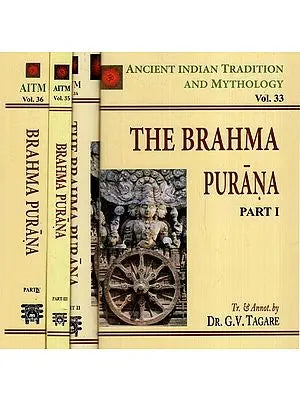
Brahma Purana: 4 Volumes
Brahma Purana: 4 Volumes
Hardcover
5.0 / 5.0
(1) 1 total reviews
Couldn't load pickup availability
DETAILS :
- Author : Dr. G.P. Bhatt & Late Prof. J.L. Shastri
- Publisher : Motilal Banarsidass Publishing House
- Hardcover : 1269 Pages
- Language : English
- ISBN: Part I 8120800036; Part II 8120800346; Part III 8120801962; Part IV 8120802713;
- Weight : 2000 g
INTRODUCTION
The Purana as a class of Literature represents different phases and aspects of life lived by the people in diverse ages. It is not possible to adopt a standard definition for the class of literature that contains heterogeneous phases and aspects of life. Literally the word Purana means old A purana in therefore the record of ancient tradition. According to the lexicographer Amara Simha (c 500 A.D) a purana should treat of five subject viz creations (2) dissolution and re creation (3) Genearlogies of gods patriarchs and illustrious monarchs (4) epochs of Manus and (5) the history of ancient dynasties. The definition is applicable to the Brahma Purana as well as to the other Puranas. To illustrate Chapters 1-3 treat of Sarga and Pratisarga (dissolution). The latter is taken up again in Chs. 122-125 Chs. 4-11 treat of vamsa and Vamsancarita (the history of illustrious monarchs) Ch. 3 deals with the fourteen Manvantaras (ages of Manus) viz Svayambhuva svarocisa Uttama Raivata Caksusa vaivasvata Raibhya, Raucya, Tamasa and five savarnis surya daksa Brahma dharma and rudra.
But the definition was found inadequate even in the early age of Puranas. It could not cover the entire contents of the Purana. The scope of definition was therefore enlarged even at the stage when the Purana literature was in the offing. The Bhagavata Purana added five more characteristics to the panca laksana purana. They were vrtti (means of livelihood) Raksa (incarnations for the protection of the people) Mukti (final Release) Hetu (unmanifest primordial nature) and apasraya (Brahma) but even this dasa Laksana definition could not full cover all aspects. Hence the Matsya Purana provided a definition approaching nearer to the description of the extant Puranas. According to this definition the Purana included the glorification of Braham visnu Surya and Rudra as also of Dharma artha and Kama.
But neither the Pancalaksana nor the Dasalaksana nor the Matsya Purana definition of the Purana could cover such topics as Tirtha yatra etc. with changes in the peoples mode of behavior the Purana introduced various other subjects which could not be covered by any definition. However this class of literature was definable only by the etymological meaning of the word Purana that is old.
The Padma Purana classifies Brahma Purana as Rajasa and assigns it to Brahma the god of rajas quality. This conforms to the statement of Matsya that the Rajasa Puranas are assignable to Brahma or Agni sattvika to Visnu tamas to Siva. The Puranas are classifiable as sattvika rajasa and tamasa on the strength of quality which they possess predominantly. But as the study reveals the Brahma is more sattvika than rajasa. A considerable portion of this purana is devoted to the glorification of Purusottama vasudeva Srikrshna Sun god and Siva. The Purana speaks of Ekama ksetra and Purusottam ksetra as sacred to Siva and Visnu respectively visnu and Siva are paramount lords while Brahma occupies the third position. Brahma himself speaks highly of Visnu and Siva.
But the Purana takes its name after Brahma. It is because Braham is the main speaker here. It is Brahma who narrates this Purana to the sages on mount meru. The version with certain modifications was repeated by Vyasa to the sages at Kuruksetra and by his disciple Romaharsana to the sages at Naimisa. The Purana derives its name merely because it has appeared through the mouth of Brahma.
According to the Narada Purana Brahma Purana contains 10,000 verses. This is corroborated by Linga varaha kurma and padma Puranas. The Matsya Purana however gives the number as 1300 though some of the mss of the Matsya Purana read this number as 10,000. In fact if we divide the Krahma Purana into 2 parts arbitrarily (although there is no mention of this division in the purana itself) part 1 containing 138 adhyayas comprising 10,000 verses and part 2 comprising Gautami Mahatmya containing 4000 verses the number comes to 14000 verses which is supported by Devibhagavata. But whether Gautami Mahatmya is a part of Brahma Purana or an independent work has always been an open question. The Narada Purana excludes gautami mahatmya from the contents of Brahma Purana. This shows that Narada Purana did not recognize Gautami as a part of Brahma Purana. From this we can conclude that the original Brahma Purana much have comprised 10,000 verses approximately.
Share