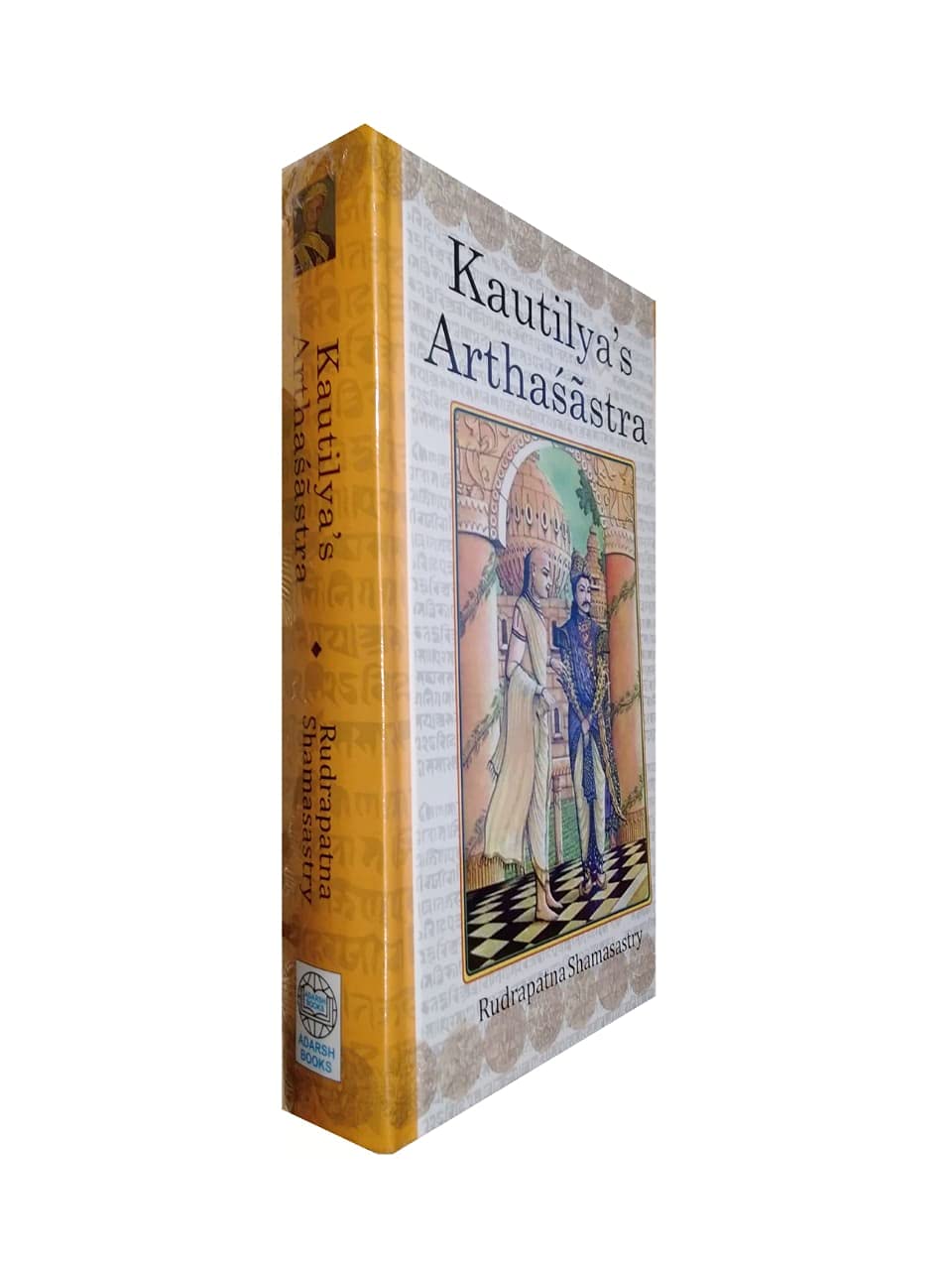
Kautilya's Arthasastra
Kautilya's Arthasastra
Hardcover
Couldn't load pickup availability
DETAILS :
- Author : R. Shamasastry and J. F. Fleet
- Publisher : Adarsh Enteprises
- Publication date : 1 January 2021
- Language : English
- Hardcover : 450 pages
- ISBN-10 : 8183631991
- ISBN-13 : 978-8183631990
- Item weight : 500 g
ABOUT THE BOOK
Kautilya’s Arthasastra, translated by the pioneering Sanskrit scholar Dr. R. Shamasastry and featuring an authoritative introductory note by the eminent British epigraphist Dr. J. F. Fleet, is a historic milestone in global Indology and political literature. First published in 1915 by the Government Press in Bangalore, this landmark volume presented the modern world with its very first English translation of ancient India's premier treatise on statecraft, economic policy, and military strategy. Prior to its physical discovery, the text was believed to be lost to time, known only through fragmented cross-references and passing citations in later classical works.
The content of the Arthasastra—traditionally attributed to Chanakya (Vishnugupta), the brilliant prime minister who overthrew the Nanda dynasty and established the Maurya Empire under Chandragupta around 321–296 BCE—functions as a clinical, pragmatic manual for ruling an empire. Shamasastry’s translation systematically unfolds Kautilya’s fifteen books, which span topics as diverse as civil administration, judicial law, fiscal management, trade regulations, and municipal planning. The text is celebrated for pioneering the Saptanga theory of the state (defining the seven structural elements of governance) and the Mandala theory of foreign policy, which acts as a complex geopolitical map mapping out how a state must navigate relations with neighboring allies and adversaries.
Rather than viewing governance through a purely religious lens, the text detaches statecraft from theological dogmas, treating Artha (material wealth and worldly success) as a foundational pursuit that underpins all other human goals. Shamasastry meticulously captures the dry, laconic, and highly technical tone of the original Sanskrit text, translating detailed statutory frameworks concerning things like currency standards, intelligence-gathering through networks of wandering spies, the containment of public corruption, and the deployment of psychological warfare during defensive and offensive military campaigns.
ABOUT THE AUTHOR
Dr. Rudrapatna Shamasastry (1865–1944) was an intellectual titan and a dedicated Sanskrit scholar who permanently altered the landscape of global historical research. While serving as the librarian of the Government Oriental Manuscripts Library in Mysore, a traditional pandit from the Tanjore district handed over a rare, unexamined 17th-century palm-leaf manuscript to the institution in 1904. Recognizing it as the legendary, long-lost Arthasastra, Shamasastry dedicated years of exhausting analytical labor to decoding its cryptic, archaic phrases. He single-handedly published the raw Sanskrit text in 1909 and his completed English translation in 1915, a monumental feat of scholarship that exploded the Eurocentric myth that ancient India lacked a tradition of pragmatic, secular, and realistic political philosophy.
Dr. John Faithful Fleet (1847–1917) was an exceptionally distinguished British civil servant, epigraphist, and historian who served as the de facto leader of the Royal Asiatic Society. His extensive work deciphering ancient Indian inscriptions and establishing chronological timelines made him uniquely qualified to evaluate Shamasastry’s discovery. In his vital introductory note to the book, Fleet championed the text’s extreme historical value, famously noting how it beautifully verified and expanded upon the fragmentary fragments left behind by the Greek ambassador Megasthenes. Fleet's scholarly endorsement was instrumental in legitimizing the translation within international academic circles, ensuring its immediate integration into global political science and comparative history curricula.
Share