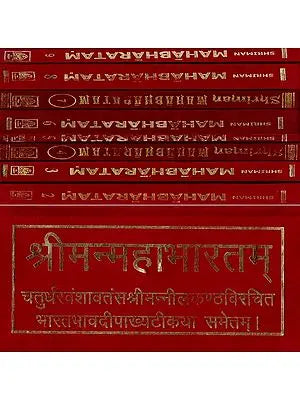
Mahabharata with the Commentary of Nilakantha (Sanskrit Only in 9 Volumes) (An old and Rare Book)
Mahabharata with the Commentary of Nilakantha (Sanskrit Only in 9 Volumes) (An old and Rare Book)
Hardcover
Couldn't load pickup availability
DETAILS :
- Publisher: Nag Publication, Shri Lal Bahadur Shastri Rashtriya Sanskrit Vidyapeetha
- Language: SANSKRIT only
- Pages: 5000
- Cover: Hardcover
- Weight : 9400
- Edition: 2019
ABOUT THE SET
Mahabharata with the Commentary of Nilakantha (Sanskrit Only in 9 Volumes), famously known as the Bharatabhavadipa (Light on the Inner Significance of the Mahabharata), is a monumental milestone in classical Indology and textual scholarship. Published by Nag Publishers with critical editorial contributions and an introductory overview by the legendary Sanskritist Dr. Mandan Mishra, this nine-volume masterwork stands as an authoritative archival collection. This set is explicitly sought after as an "old and rare book" because it preserves the unadulterated, comprehensive Sanskrit textual tradition, capturing the full magnitude of the world’s largest epic poem alongside its most celebrated historical exegesis.
The primary objective of this expansive compilation is to present the classical, unabridged text of the Mahabharata alongside the definitive prose exposition authored by the seventeenth-century scholar Nilakantha Chaturdhara. Spanning approximately five thousand pages across the nine individual bindings, the textual material completely bypasses modern Westernized or translated modifications, rendering the verses and their corresponding explanations entirely in pristine Devanagari script. Structurally, the set divides the eighteen primary Parvas (books) into logical, chronologically sound volumes. Volume one introduces the origins via the Adi and Sabha Parvas, transitioning seamlessly into the massive Vana and Virata Parvas in volume two, and working systematically through the heavy conflict and philosophical treatises of the Udyoga, Bhisma, Drona, Karna, and Shanti Parvas, before concluding with the final metaphysical ascents in the remaining sections.
What elevates this specific version to an irreplaceable status among traditional pundits, Indologists, and advanced university researchers is the inclusion of Nilakantha’s Bharatabhavadipa. Writing from Varanasi during a period of intense intellectual renaissance, Nilakantha synthesized the works of much older commentators like Devabodha and Arjunamishra to establish a unified hermeneutic model. His writing is highly unique because it approaches the massive battlefield narratives from the philosophical standpoint of Advaita Vedanta (non-dualism), treating the outer struggles of the Pandavas and Kauravas as deep, allegorical transformations of the human soul striving for Dharma and Moksha. Furthermore, Nilakantha famously integrated contemporary socio-political updates into his commentaries, occasionally using analogies drawn from advanced military technology or eyeglasses to clarify ancient concepts. Complete with a comprehensive Sloka (verse) index and an exhaustive geographical name dictionary across the concluding volumes, this collection functions as an invaluable linguistic and spiritual reference library for classical libraries and traditional institutions.
ABOUT THE AUTHORS AND COMMENTATORS
Rishi Veda Vyasa is the traditional, universally revered composer and compiler of the core Mahabharata text, regarded in Indian tradition as an avatar of Vishnu who categorized the primary Vedic wisdom into accessible epic narratives for humanity. His poetic framework serves as the definitive structural skeleton upon which all subsequent classical Indian philosophy, ethics, and narrative arts were built over successive millennia.
Nilakantha Chaturdhara (17th Century CE) was an extraordinary scholar, polymath, and Advaitin dialectician born into a prominent Marathi-speaking Brahmin family situated along the banks of the Godavari River. He eventually migrated to Varanasi, the ultimate hub of traditional Shastric education, where he mastered the complex matrices of the Vedas, Mimamsa, Yoga, Saiva texts, and Tarka under spiritual masters like Lakshmanarya and Narayana Tirtha. Beyond his legendary masterpiece on the Mahabharata, Nilakantha produced several other profound commentaries, including the Mantra Ramayan and expositions on the Ganesha Gita, earning him a lasting legacy as one of the most brilliant post-medieval Indian philosophers.
Share