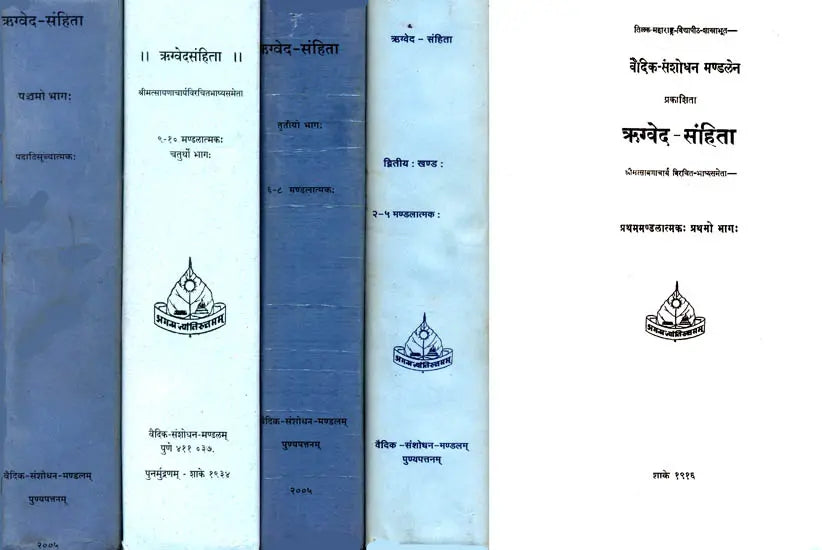
Rgveda-Samhita with the Commentary of Sayana (In Five Volumes): Sanskrit Only (An Old and Rare Book)
Rgveda-Samhita with the Commentary of Sayana (In Five Volumes): Sanskrit Only (An Old and Rare Book)
Hardcover
Couldn't load pickup availability
DETAILS :
- Publisher: Vaidika Samshodhana Mandala, Pune
- Language: sanskrit
- Hardcover : 5220 Pages
- Edition: 1995
- Weight : 9500 g
ABOUT THE BOOK
The Rgveda-Samhita with the Commentary of Sayana is arguably the most significant publication for any serious scholar of Indology or Vedic studies. This five-volume set presents the Rgveda, the oldest and most foundational of the four Vedas, preserved in its purest Sanskrit-only form. What makes this particular edition indispensable is the inclusion of the Sayanabhasya—the definitive 14th-century commentary by Sayanacharya. Without Sayana’s meticulous breakdown of grammar, etymology, and ritual context, many of the cryptic and archaic Vedic verses would remain impenetrable to modern readers.
This monumental collection organizes the 1,028 hymns (Suktas) into ten books (Mandalas). It follows the Samhita Patha (the continuous phonetic version) and is often used alongside the Pada Patha (word-for-word breakdown) to ensure the exact preservation of the sacred vibrations of the text. For the traditional scholar, this set is not just a book but a "Vangmaya Tapasya" (intellectual penance), providing the linguistic tools necessary to decode the philosophical, astronomical, and liturgical layers of the world’s oldest living tradition.
ABOUT THE COMMENTATOR
Sayanacharya (died 1387 CE) was a brilliant polymath and the Prime Minister in the Vijayanagara Empire under King Harihara II. He was a master of the Vedas, and his commentaries (Bhasyas) are considered the standard by which all subsequent Vedic interpretations are measured. Supported by a team of scholars and his brother, the great sage Vidyaranya, Sayana’s mission was to revive Vedic knowledge during a period of cultural transition. His work bridges the gap between the ancient seers (Rishis) and the medieval intellectual tradition, providing the grammatical keys (Vyakarana) that unlocked the Vedas for generations to come.
Share