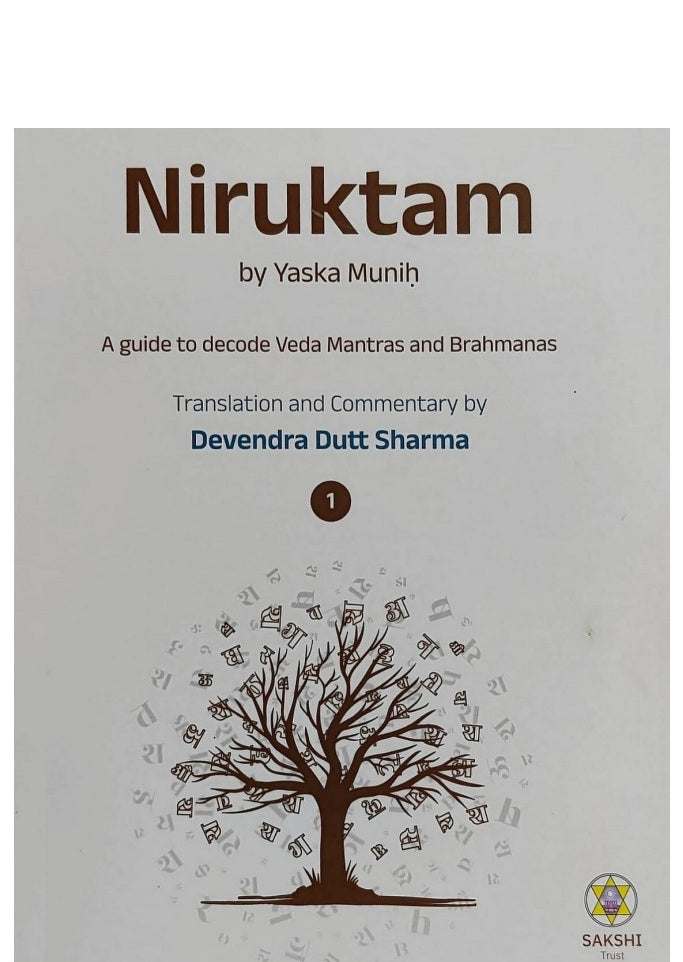
Niruktam by Yaska Muniḥ A guide to decode Veda Mantras and Brahmanas Translation and Commentary by Devendra Dutt Sharma Sakshi Trust India
Niruktam by Yaska Muniḥ A guide to decode Veda Mantras and Brahmanas Translation and Commentary by Devendra Dutt Sharma Sakshi Trust India
Couldn't load pickup availability
Niruktam (2 Volumes Set) by Devendra Dutt Sharma Sakshi Trust India ISBN: 9788179942451
Rig Veda, the very source of Indian culture, contains meanings and mysteries, which can
only be apprehended and appreciated with the help of Nirukta, which is an etymological
and semantic treatise meant only for this purpose. Among twelve Niruktas that we have
references to, it is only Yaska's that is available to us. And we have fortunately the text
intact. There is also an extensive commentary on it by Bhagavad-Durga (Durgacharya) and
some glossatorial notes by Skanda-svamin.
Yaska was an ancient Indian grammarian and linguist (7th - 5th century BCE). His Nighantu
is considered as the oldest proto-thesaurus in India. Yaska is widely regarded as the
precursive founder of the discipline of what would become etymology in both the East and
West. The Nirukta has three parts i) Nighantuka, a collection of synonyms (ii) Naigama, a
collection of words peculiar to the Vedas and iii) Daivata, words relating to deities and
Yajnas. Nirukta or etymology is one of the Vedangas or compulsory subjects in the syllabus
of Vedic expertise in ancient India.
This work on Nirukta is a definite contribution to the field of Vedas. Understanding the
Vedas from psychological viewpoint i.e. adhyatma is more important and D.D. Sharma's
meticulous work is of great help in this path.
Sri Devendra Dutt Sharma is born in 1947 in the family of Vaidya. He was brought up in
religious atmosphere, where Sanskrit and meditation were in prominence. When he was in
fourth grade, he read Adi Sankarácáya saying 'if you know yourself, there is nothing else to
be known'. He decided to know who I am.
In 1961, China attacked India. He thought of serving our mother land. He joined Indian Navy.
There, besides learning electronics, he did M.A. in Sociology from Vikram University, Ujjain.
He left Indian Navy and joined Customs and Central Excise. While in service he met his guru
Svami Vishnu Asram, who gave him díkshá in meditation and study of Veda. While studying
Veda he regularly came across the term 'it is explained by Yaska in Niruktam'. He started
studying Niruktam. This commentary on Niruktam is the result of that study and
meditation for years.
Share