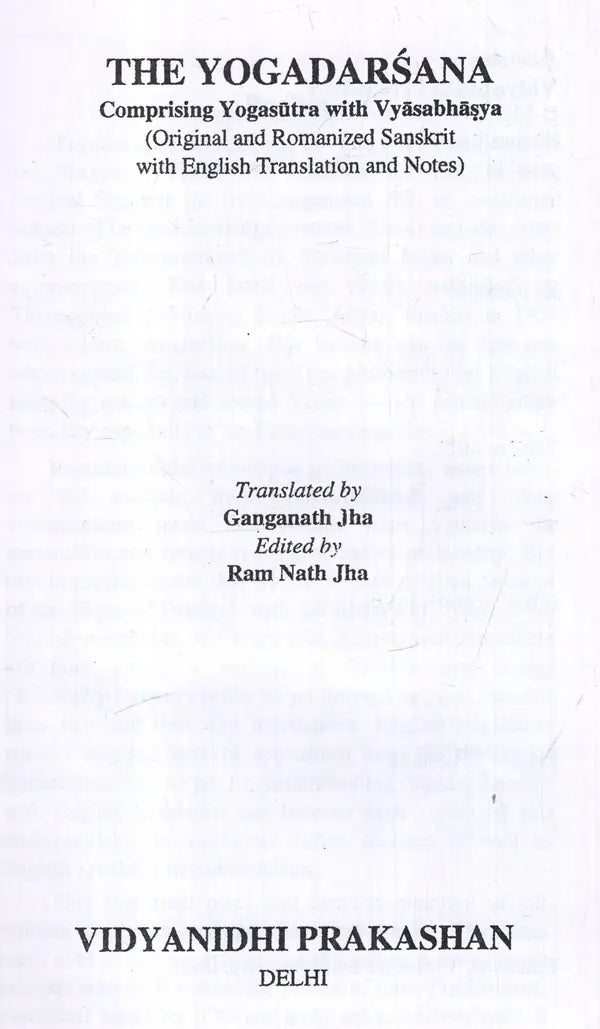
The Yogadarsana- Comprising Yogasutra with Vyasabhasya (Original and Romanized Sanskrit with English Translation and Notes)
The Yogadarsana- Comprising Yogasutra with Vyasabhasya (Original and Romanized Sanskrit with English Translation and Notes)
HARDCOVER
Couldn't load pickup availability
Details :
Publisher : Vidyanidhi Prakashan, Delhi
Author : Ganganath Jha
Language : Sanskrit Text With Translitration and English Translation
Pages : 384
Cover : HARDCOVER
Dimension : 21.5 cm x 14 cm
Weight : 574 gm
Edition : 2021
ISBN : 9789385539169
About the Book
The Yogadarsana comprises the Sutras of Patanjali along with the Bhasya of Vyasa. The texts are in original Sanskrit and also in romanized form. The English translation with invaluable notes by Mahamahopadhyaya Dr. Sir Ganganath Jha opens the gate of Yogic wisdom enshrined in these two foundational texts along with Tattvavaisaradi of Indian Yoga tradition. The exhaustive preface is also helpful to understand the summary of Yoga philosophy.
Preface
Yogadarsana, comprising the Sutras of Patanjali with the Bhasya of Vyasa, was translated into English from original Sanskrit by Dr. Ganganatha Jha, an acclaimed scholar of Indian knowledge systems. It also includes notes from the Tattvavaisaradi of Vacaspati Misra and other commentaries. This book was firstly published by Theosophical Publishing House, Adyar, Madras in 1934 with a long introduction. This volume was the first one which opened the door of the Yoga philosophy for English speaking readers and spread Vedic thought across Indian boundary especially to the European countries.
Important notes on serious philosophical issues based on the extracts from Tattvavaisaradi and other commentaries made this volume more valuable for researchers and serious readers of Indian philosophy. But one important aspect that was to include original Sanskrit of the Sutras of Patanjali with the Bhasya of Vyasa to the English translation of Ganganatha Jha required immediate attention. Being a student of Sanskrit and Indian philosophy I always prefer to go through original Sanskrit lines first and then any translations. English translation without original Sanskrit sometimes loses the rhythm of textual meaning. As per my understanding original Sanskrit with English translation can become more beneficial and understandable to traditional Indian scholars as well as English speaking western scholars.
Other important point that requires attention in this volume is the un-updated diacritical marks. Diacritical mark used in the first quarter of 20th Century is not so much relevant now as it was in that period of time.
Share