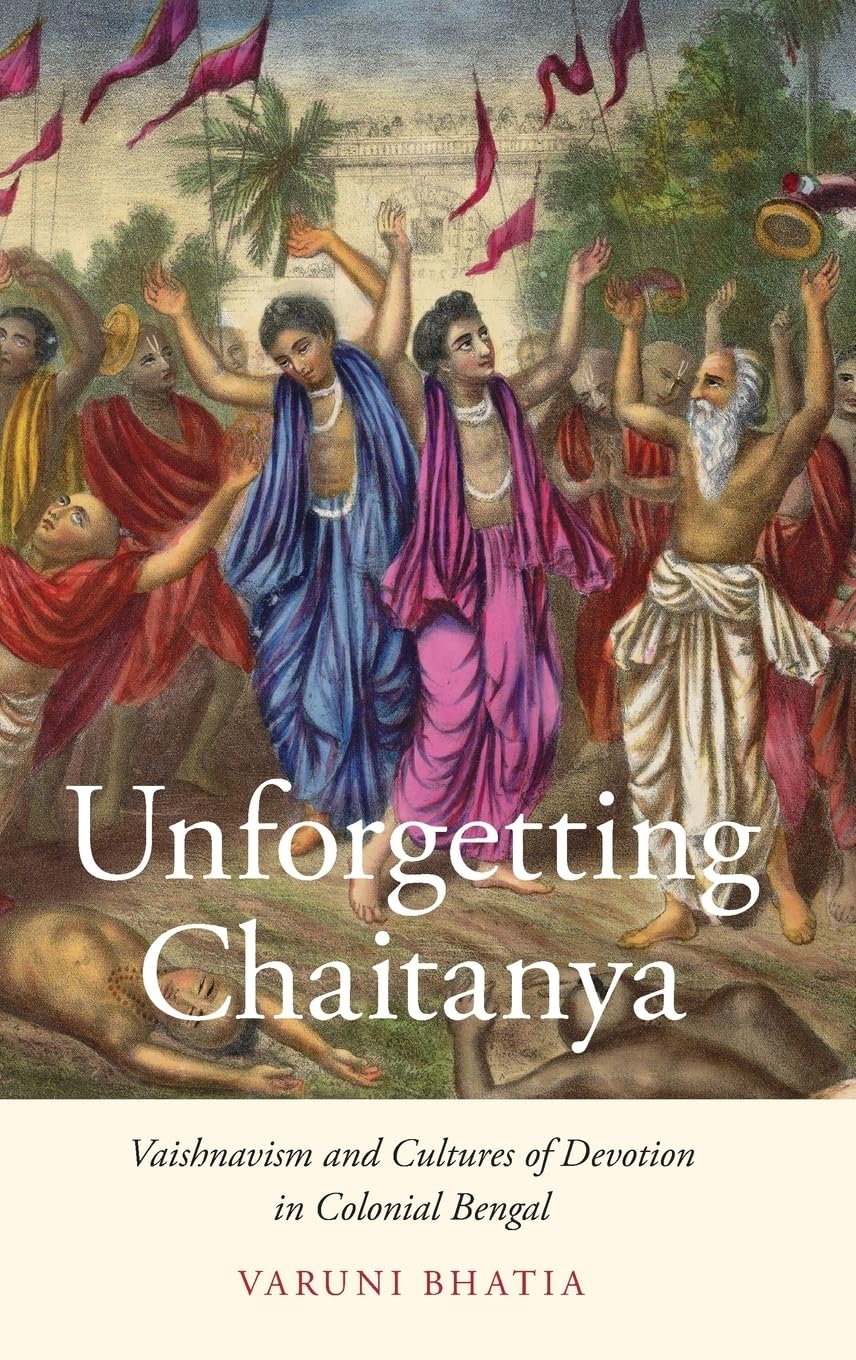
Unforgetting Chaitanya: Vaishnavism and Cultures of Devotion in Colonial Bengal
Unforgetting Chaitanya: Vaishnavism and Cultures of Devotion in Colonial Bengal
Paperback
Couldn't load pickup availability
DETAILS :
- Publisher : Oxford University Press
- Author : Varuni Bhatia
- Language : English
- Paperback : 294 pages
- Weight : 450 g
ABOUT THE BOOK
What role do pre-modern religious traditions play in the formation of modern secular identities? In Unforgetting Chaitanya, Varuni Bhatia examines late-nineteenth-century transformations of Vaishnavism--a vibrant and multifaceted religious tradition emanating from the Krishna devotee Chaitnaya (1486-1533)--in Bengal. Drawing on an extensive body of hitherto unexamined archival material, Bhatia finds that both Vaishnava modernizers and secular voices among the educated middle-class invoked Chaitanya, portraying him simultaneously as a local hero, a Hindu reformer, and as God almighty. She argues that these claims should be understood in relation to efforts to recover a "pure" Bengali culture and history at a time of rising anti-colonial sentiment.
In the late nineteenth century, debates around questions of authenticity appeared prominently in the Bengali public sphere. These debates went on for years, even decades, causing unbridgeable rifts in personal friendships and tarnishing reputations of established scholars. Underlying them was the question of "true" Bengali Vaishnavism and its role in the long-term constitution of Bengali culture and society. Who was an authentic Vaishnava? Many authors excluded those groups and communities whose practices they found unacceptable according to their definition of Vaishnava authenticity. At stake in these discourses, argues Bhatia, was the nature and composition of an indigenously-derived modernity inscribed through what she calls the politics of authenticity. It allowed an influential section of Hindu Bengalis to excavate their own explicitly Hindu past in order to find a people's history, a religious reformer, a casteless Hindu sect, the richest examples of Bengali literature, and a sophisticated expression of monotheistic religion.
ABOUT THE AUTHOR
Varuni Bhatia is a scholar in Hindu and South Asian Studies. She is (or was) Assistant Professor at the University of Michigan, Ann Arbor. Her research focuses on religious modernity, colonialism, and devotional traditions in South Asia. In this book, she combines methods from history, religious studies, and cultural analysis to probe how memory and religious identity intersect. Bhatia’s work shows sensitivity to caste, linguistic, and regional dimensions of Bengali Vaishnavism in the colonial period. She contributes to scholarship on how pre-modern religious figures like Chaitanya are reinterpreted in modern, nationalist contexts.
Share