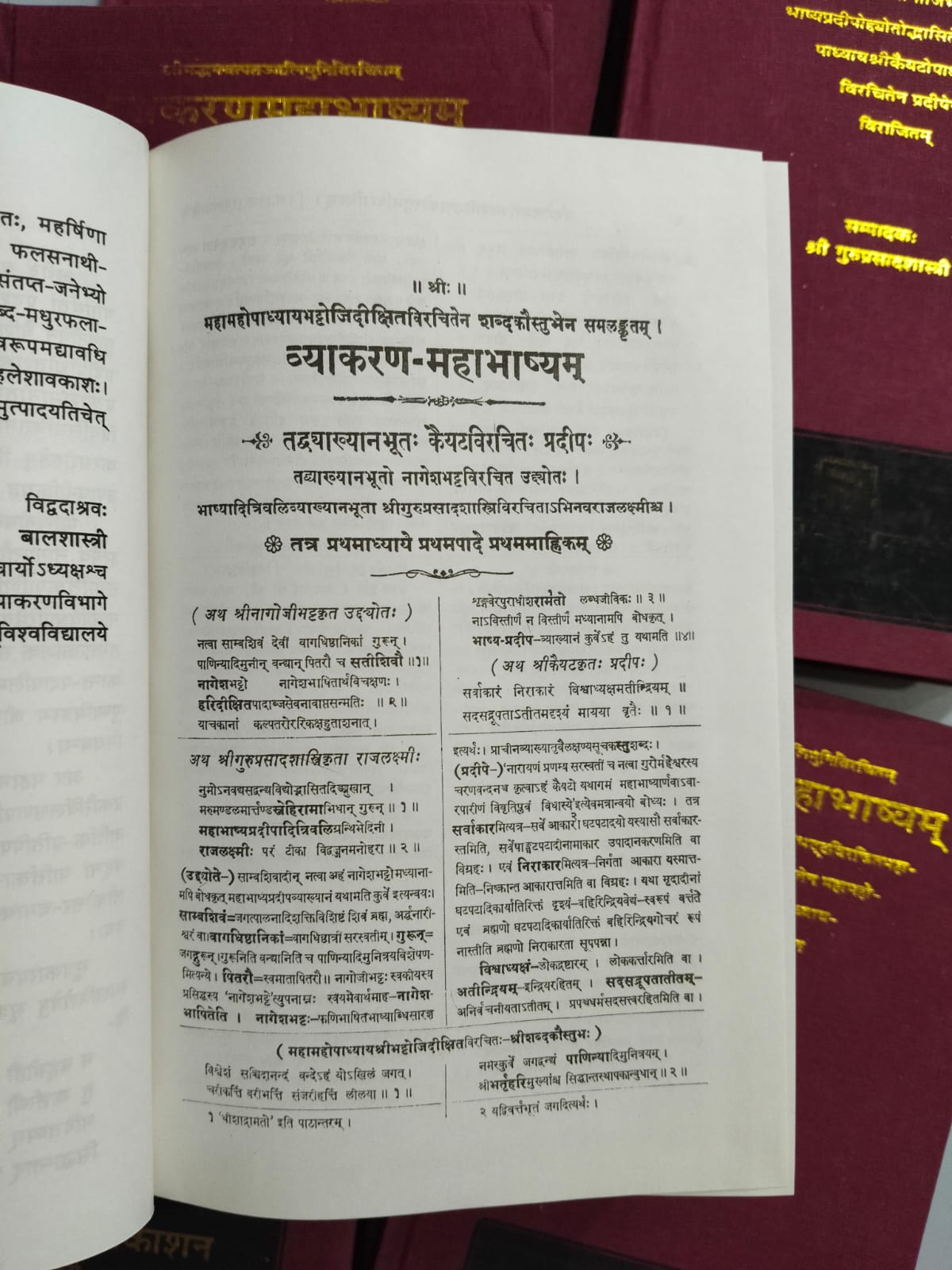
व्याकरणमहाभाष्यम्- Patanjali's Vyakarna Mahabhasya with 4 Commentaries (Set of 6 Volumes)
व्याकरणमहाभाष्यम्- Patanjali's Vyakarna Mahabhasya with 4 Commentaries (Set of 6 Volumes)
Hardcover
Couldn't load pickup availability
DETAILS:
- Publisher: Pratibha Prakashan
- Author: Bal Shastri (Edt.)
- Language: Sanskrit Only
- Pages: 3362
- Cover: HARDCOVER
- Weight: 4800 G
- Edition: 2001
- ISBN: 8177020323
ABOUT THE BOOK
वैयाकरणमहाभाष्यम् (Vyakarana Mahabhasya) of Maharishi Patanjali, edited by the legendary 19th-century Sanskrit scholar and logician Mahamahopadhyaya Pandit Bal Shastri, is the absolute peak of ancient Indian linguistic philosophy and grammatical science. This monumental six-volume text-critical edition (traditionally published by premier institutions like the Chowkhamba Sanskrit Series Office or Prachya Prakashan) stands as the definitive research edition of Patanjali's masterwork. The core philosophy of this text centers on the absolute authority of the spoken word (Shabdanushasana) and structural perfection—serving as the supreme analytical commentary on Katyayana’s critical verses (Varttikas) and Panini’s core grammatical formulas (Ashtadhyayi). Together, these three sages are revered as the Munitraya (the trinity of Sanskrit grammar).
Written entirely in classical academic Sanskrit, the Mahabhasya is far more than a technical manual on word derivation. It is a brilliant philosophical treatise that lays the groundwork for all subsequent Indian systems of semantics, logic (Nyaya), and hermeneutics (Mimamsa). Patanjali introduces a highly engaging, dynamic dialogue style (Vakkyartha-Vichara) where an interrogator (Purvapakshin) and a concluding authority (Siddhantin) engage in sharp, rapid intellectual debates. Through this framework, the text analyzes the fundamental nature of language, asking deep structural questions: What constitutes a word? What is the relationship between a sound wave (Dhvani) and its permanent mental meaning? How do individual word meanings combine to create the holistic meaning of a complete sentence?
The Four Included Commentaries
To provide scholars with an uncompromised path through Patanjali’s dense structural logic, this six-volume set compiles four of the most celebrated historical sub-commentaries (Bhasya-Pradipa layers) directly alongside the core text:
- 1. The Pradipa (प्रदीप) by Acharya Kaiyata: A brilliant 11th-century Kashmiri commentary that acts as the primary analytical key to the Mahabhasya. Kaiyata focuses heavily on explaining Patanjali’s logical methods, literal definitions, and philosophical viewpoints.
- 2. The Uddyota (उद्द्योत) by Acharya Nagesha Bhatta: A massive 18th-century masterpiece of logic written over Kaiyata's text. Nagesha uses the advanced tools of Navya-Nyaya to defend Patanjali against rival schools, exploring the deep metaphysics of language.
- 3. The Chhaya (छाया) by Acharya Vaidyanatha Payagunde: A specialized, razor-sharp sub-commentary that focuses strictly on unpacking the dense, technical references left behind by Nagesha Bhatta.
- 4. The Sphurti (स्फूर्ति) / Local Shastric Annotations: Traditional textual explanations curated by Pandit Bal Shastri to bridge gaps between regional manuscript variations and oral teaching lineages.
ABOUT THE AUTHOR
Mahamahopadhyaya Pandit Bal Shastri (Balashastri Ranade) was a premier 19th-century academic star of Varanasi, widely remembered for his encyclopedic mastery over Vyakarana and Mimamsa. His critical editing of this six-volume compendium was a monumental task in manuscript collation. He gathered, cross-verified, and corrected text errors across dozens of decaying palm-leaf and paper documents to produce a highly accurate, fully integrated layout where the core Sutra, Varttika, Bhasya, Pradipa, and Uddyota are displayed together on a single page spread.
The scholarly and editorial tone of this compendium is incredibly rigorous, uncompromising, and deeply academic. The text offers no modern vernacular translations or simplified summaries, requiring the reader to be thoroughly trained in traditional Sanskrit grammar. The prose moves through dense, continuous Devanagari paragraph structures that perfectly mirror the rhythm of oral Shastric debate. This makes the six-volume set an absolute necessity for advanced indological research centers, global university manuscript archives, and serious scholars of structural linguistics worldwide.
Share