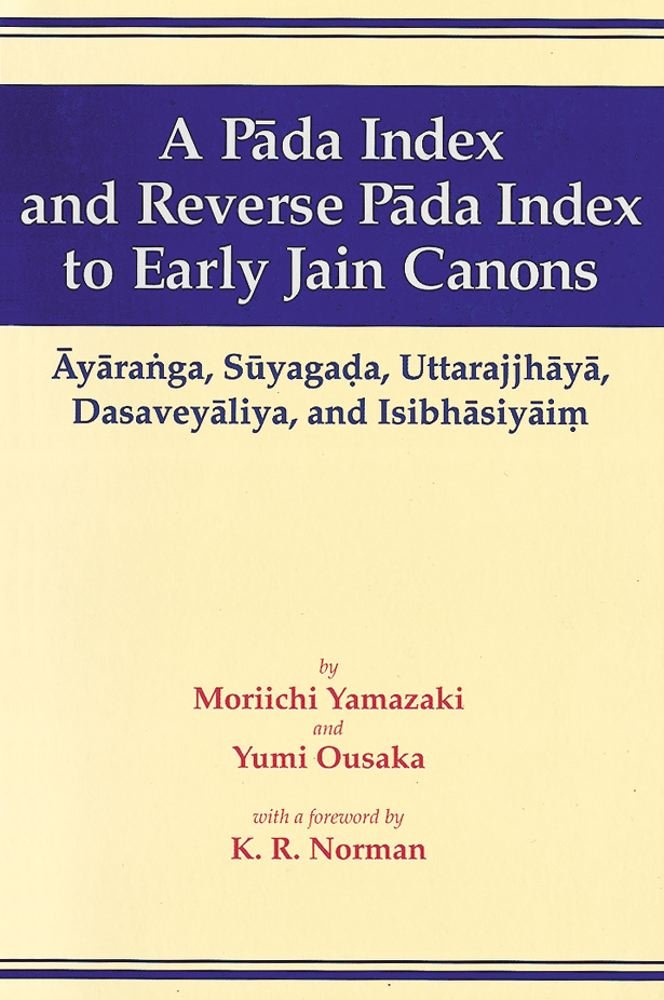
A Pada Index and Reverse Pada Index to Early Jain Canons
A Pada Index and Reverse Pada Index to Early Jain Canons
Paperback
Couldn't load pickup availability
DETAILS :
- Author : Yumi Ousaka , Moriichi Yamazaki , K. R. Norman
- Publisher : Kosei Publishing Co
- Publication date : 15 August 1996
- Edition : Original ed.
- Language : English
- Paperback : 538 pages
- ISBN-10 : 4333017637
- ISBN-13 : 978-4333017638
- Item Weight : 950 g
ABOUT THE BOOK
A Pada Index and Reverse Pada Index to Early Jain Canons is a monumental work of linguistic and textual scholarship essential for the study of Prakrit and ancient Jain literature. A "Pada Index" is an exhaustive word-by-word index (specifically of verse-quarters or metrical feet), allowing researchers to locate every instance of a specific word or phrase across the canonical scriptures. The "Reverse Pada Index" is a specialized tool where words are alphabetized starting from their last letter, which is invaluable for philologists studying grammatical suffixes, rhyme schemes, and linguistic evolution.
The work covers foundational Ardhamagadhi texts such as the Ayaranga, Suyagada, and Uttarajjhayana. By providing a systematic map of the canonical vocabulary, the authors have created a "concordance" that enables scholars to perform comparative analysis and reconstruct the historical layers of Jain thought with mathematical precision.
ABOUT THE AUTHOR
This work is the result of a high-level international collaboration between Japanese and British scholars:
- Yumi Ousaka and Moriichi Yamazaki are distinguished Japanese scholars known for their pioneering work in using computer-assisted philology to index ancient Indian texts. They have been instrumental in digitizing and organizing the linguistic data of both Buddhist and Jain canons.
- K. R. Norman (1925–2020) was one of the world's foremost authorities on Middle Indo-Aryan languages. A professor at the University of Cambridge and long-time President of the Pali Text Society, he was renowned for his unmatched expertise in Prakrit, Pali, and the Ashokan inscriptions.
Their combined expertise ensures that the index is not only technologically accurate but also grounded in deep traditional and linguistic scholarship.
Share