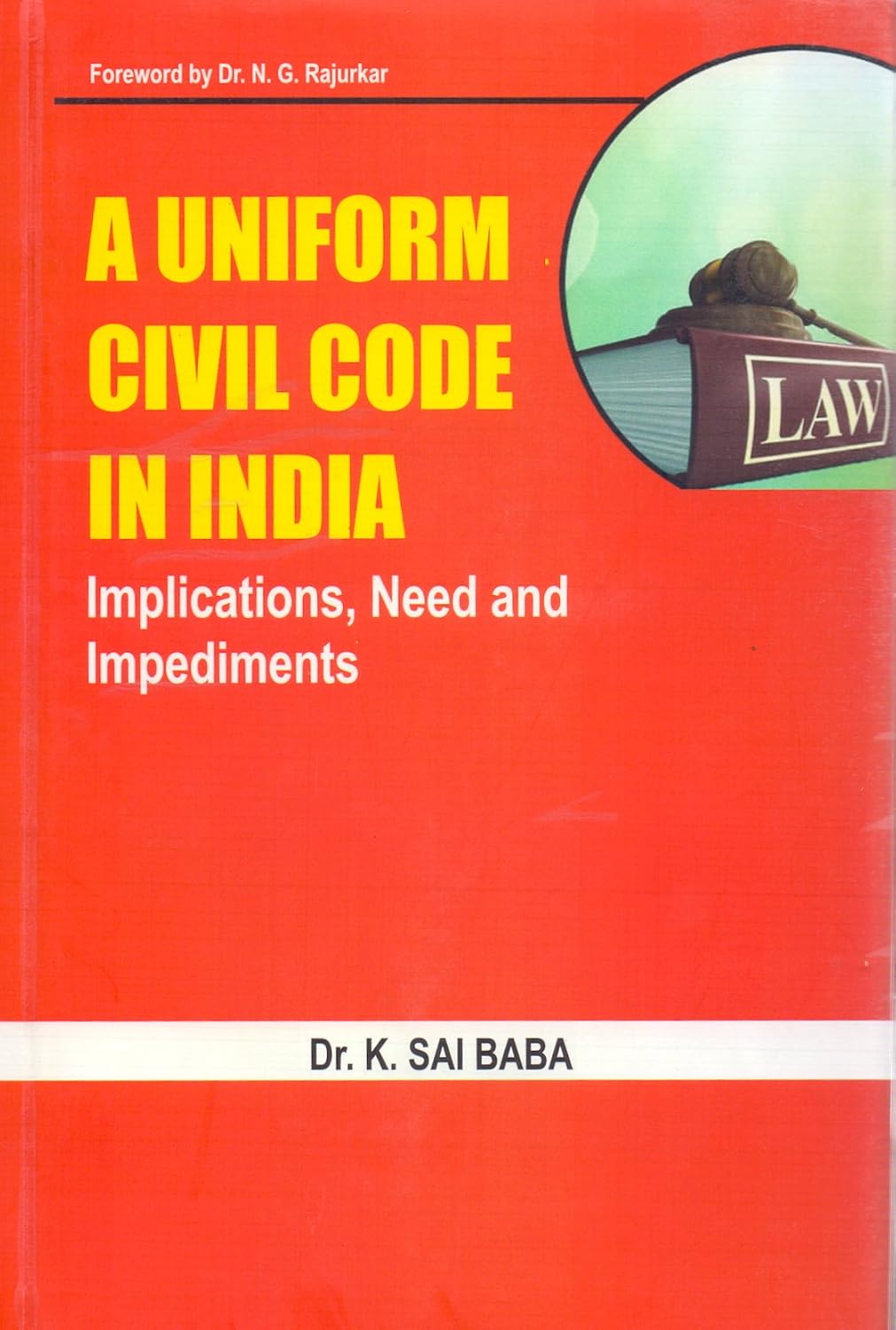
A Uniform Civil Code in India: Implications, Need and Impediments
A Uniform Civil Code in India: Implications, Need and Impediments
Hardcover
Couldn't load pickup availability
DETAILS :
- Author : K Sai Baba
- Publisher : Raj Publications (Dist.)
- Publication date : 1 January 2016
- Language : English
- Hardcover : 200 pages
- ISBN-10 : 9351710505
- ISBN-13 : 978-9351710509
- Item Weight : 500 g
ABOUT THE BOOK
A Uniform Civil Code in India: Implications, Need and Impediments, authored by the legal analyst and scholar K. Sai Baba and published in 2016 by Raj Publications, is a structured, analytical investigation into one of the most enduring and highly polarized constitutional debates in modern Indian jurisprudence. The volume serves as an objective reference manual that unpacks the complex legal, social, and political layers surrounding the proposed implementation of a single, uniform civil code across the diverse population of India.
The core objective of the book is to systematically dismantle the dense arguments for and against a Uniform Civil Code (UCC) by examining it through three specific vectors: its legal implications, its contemporary need, and its structural impediments. Sai Baba grounds his research in Article 44 of the Directive Principles of State Policy in the Indian Constitution, which mandates that the State shall endeavor to secure a uniform civil code for its citizens. The text explores how the current coexistence of distinct, religion-based personal laws—governing marriage, divorce, alimony, inheritance, and adoption—creates systemic legal fragmentation and often compromises the fundamental right to gender equality.
Rather than taking a partisan stance, the author balances his defense of secularism and gender justice with a detailed evaluation of historical anxieties. The "Impediments" section of the book carefully investigates the legitimate concerns of minority communities regarding the erosion of cultural autonomy, the protection of tribal customary laws, and the intricate challenge of balancing Article 44 with the fundamental right to freedom of religion under Articles 25 and 26. By tracking landmark judicial interventions—such as the historic Shah Bano and Sarla Mudgal cases—the text illustrates how the Supreme Court of India has routinely nudged the legislature toward reform,
ABOUT THE AUTHOR
K. Sai Baba is a dedicated legal researcher, author, and academician specializing in Indian constitutional law and personal law systems. Known for his methodical, text-based research, his work focuses on analyzing the evolving relationship between state legislation, traditional religious customs, and constitutional fundamental rights in South Asia.
Sai Baba's writing style is defined by its strict scholastic detachment, objective structural logic, and clarity of prose. He excels at breaking down dense statutory legalese and conflicting constitutional provisions into highly accessible, logically arranged chapters. His academic philosophy centers on promoting informed civic discourse, and this publication stands as a testament to his commitment to providing an unbiased baseline for evaluating complex national policy transitions.
Share