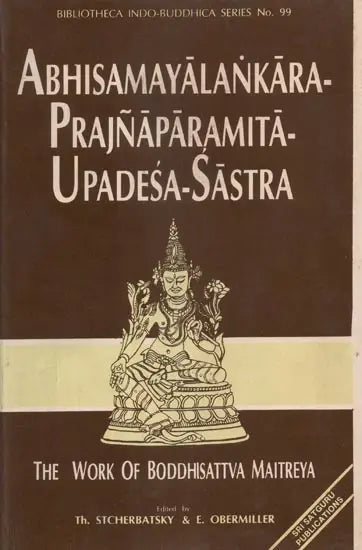
Abhisamayalankara- Prajnaparamita- Upadesa- Sastra (The Work of Boddhisattva Maitreya)
Abhisamayalankara- Prajnaparamita- Upadesa- Sastra (The Work of Boddhisattva Maitreya)
Hardcover
Couldn't load pickup availability
DETAILS :
- Publisher: Sri Satguru Publications
- Author: Stcherbatsky and E. Obermiller
- Language: SANSKRIT TEXT WITH TIBETAN AND ENGLISH Translation
- Pages: 72
- Cover: HARDCOVER
- Weight 280 gm
- Edition: 1992
- ISBN: 9788170303046
ABOUT THE BOOK
The Abhisamayalankara is one of the five works upon which the Yogacara School of later Buddhism is founded, and whose authorship is, according to the Tibetan tradition, ascribed to Bodhisattva Maitreya, the future Buddha. This book is divided into 8 Chapters. The first three deal with three kinds of Omniscience, the Omniscience of the Mahayanistic Buddha (sarva-akara-jnata), the Omniscience of the Bodhisattva concerning the Path (marga-jnata) and that kind of Omniscience which is attainable by the Hinayanistic Saint (sarva-jnata). This term of Omniscience, as applied to the Buddha carries a totally different connotation than in western religions. It simply means intelligible, non- sensuous, intuition, the direct presentation of the world sub specie aeternitatis. The next four Chapters contains the four so called prayogas or ways of realisation of that omniscience. Finally the 8th chapter contains the doctrine of Buddha's Cosmical Body (dharmakaya), or of the disappearing that omniscience, or of the disappearing of the individuals in the monistic Absolute.
The Sanskrit text of the Abhisamayalankara has been prepared from to Mss. of the Cambridge University Library. They are respectively referred to as Mss. A and B. The whole text of the Abhisamayalankara is moreover contained in Haribhadra's Aloka. It is referred to as Mss. C.
The Tibetan translation is the work of the great translator Ng Lodan-Seirab, with the colloboration of the Indian pandit Amaragomin.
ABOUT THE AUTHOR
This edition brings together two of the most influential figures in the history of Buddhist studies:
- Th. Stcherbatsky (Fyodor Shcherbatskoy, 1866–1942): A Russian Indologist who is often called the "father of Western Buddhist logic." He was instrumental in presenting Buddhism to the West not just as a religion, but as a sophisticated system of philosophy and logic comparable to Kant and Hegel. His work on the Buddhist Logic remains a masterpiece in the field.
- E. Obermiller (Eugene Obermiller, 1901–1935): A brilliant student of Stcherbatsky, Obermiller was a prodigy who mastered Tibetan and Sanskrit. He spent years in Buryatia studying with traditional lamas, which allowed him to bring an "insider's" depth to his academic translations. His work on the Uttaratantra and the Abhisamayalankara set the standard for modern Tibetan Buddhist scholarship before his untimely death at the age of 33.
Share