1
/
of
1
Agroclimatology of Vegetable Crops: Classification and Cultivation
Agroclimatology of Vegetable Crops: Classification and Cultivation
Regular price
$59.52 USD
Regular price
$99.20 USD
Sale price
$59.52 USD
Unit price
/
per
Couldn't load pickup availability
Author : BV Ramana Rao, Surender Singh, SK Dhankhar & V Uma Maheswara Rao
Pages : 242
Year of Publication : 2026
Language : English
Binding : Hardback
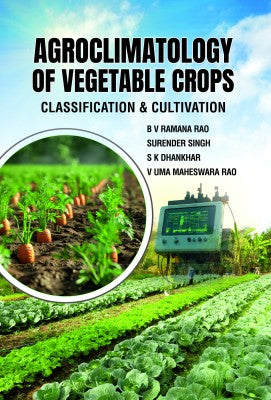
The book “Agroclimatology of Vegetable Crops: Classification and Cultivation” is a specialized academic resource that focuses on the interplay between climate and vegetable crop production. This book delves into the principles of agroclimatology with a specific focus on vegetable cultivation, addressing both scientific foundations and practical applications. It emphasizes the role of climate elements—such as temperature, rainfall, humidity, sunshine, and wind—in determining the growth, development, yield, and quality of various vegetable crops. Each chapter integrates agroclimatic insights with crop physiology, offering detailed analyses of weather-sensitive stages in vegetables like tomato, potato, onion, cabbage, and leafy greens. The book also examines how climate variability and extreme weather events, exacerbated by climate change, impact vegetable farming systems. In response, it proposes adaptive strategies including altered sowing dates, microclimate management, use of climate-resilient varieties, and adoption of protected cultivation practices like greenhouses and net houses. The text highlights the importance of agrometeorological services such as weather forecasting, early warning systems, and advisories tailored to vegetable farmers. Various tools/techniques are also discussed for precision planning and resource optimization. Through case studies and regional analyses, the book offers practical insights for diverse agroecological zones, supporting both smallholders and commercial growers. It serves as a vital resource for researchers, extension specialists, policymakers, and students by linking agroclimatic science with strategic planning and sustainable olericultural development.
Pages : 242
Year of Publication : 2026
Language : English
Binding : Hardback
The book “Agroclimatology of Vegetable Crops: Classification and Cultivation” is a specialized academic resource that focuses on the interplay between climate and vegetable crop production. This book delves into the principles of agroclimatology with a specific focus on vegetable cultivation, addressing both scientific foundations and practical applications. It emphasizes the role of climate elements—such as temperature, rainfall, humidity, sunshine, and wind—in determining the growth, development, yield, and quality of various vegetable crops. Each chapter integrates agroclimatic insights with crop physiology, offering detailed analyses of weather-sensitive stages in vegetables like tomato, potato, onion, cabbage, and leafy greens. The book also examines how climate variability and extreme weather events, exacerbated by climate change, impact vegetable farming systems. In response, it proposes adaptive strategies including altered sowing dates, microclimate management, use of climate-resilient varieties, and adoption of protected cultivation practices like greenhouses and net houses. The text highlights the importance of agrometeorological services such as weather forecasting, early warning systems, and advisories tailored to vegetable farmers. Various tools/techniques are also discussed for precision planning and resource optimization. Through case studies and regional analyses, the book offers practical insights for diverse agroecological zones, supporting both smallholders and commercial growers. It serves as a vital resource for researchers, extension specialists, policymakers, and students by linking agroclimatic science with strategic planning and sustainable olericultural development.
Share