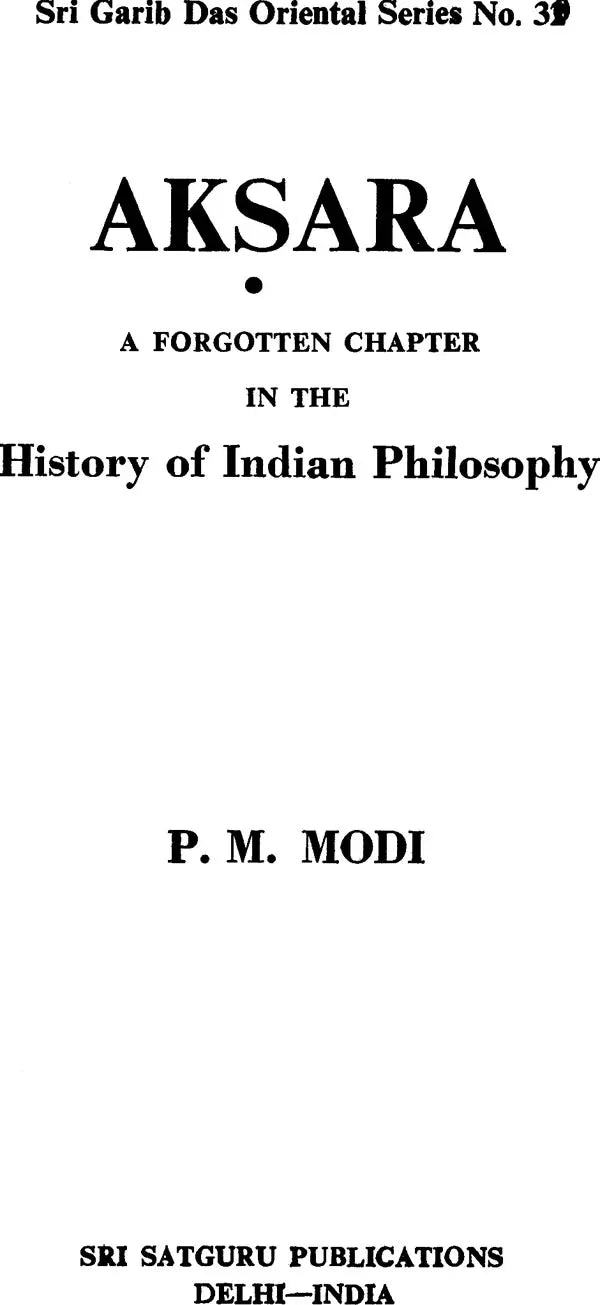
Aksara (A Forgotten Chapter in The History of Indian Philosophy) (An Old Book)
Aksara (A Forgotten Chapter in The History of Indian Philosophy) (An Old Book)
Hardcover
Couldn't load pickup availability
DETAILS :
- Publisher : Sri Satguru Publications
- Author : P.M. Modi
- Language : English
- Pages : 396
- Cover : Hardcover
- Weight : 310 gm
- Edition : 1985
- ISBN : 9788170300410
ABOUT THE BOOK
Aksara: A Forgotten Chapter in the History of Indian Philosophy is a brilliant piece of historical and philosophical detective work by Dr. P.M. Modi. Originally published in 1932 (based on his doctoral thesis at the University of Kiel, Germany), this rare book challenges mainstream narratives about the evolution of early Indian thought, specifically looking at the transition from the Upanisads to the Bhagavad Gita and the Brahma Sutras.
Dr. Modi’s central thesis revolves around the word Aksara (imperishable/syllable). He argues that in the earliest layers of post-Upanisadic philosophy, Aksara was not merely a synonym for the impersonal Brahman, but was viewed as a distinct, independent principle—often intermediate between the Supreme Personal God (Purusha) and primordial matter (Prakriti). The book is highly valued for:
- Textual Archeology: Tracking the shifting definitions of Aksara across the Mahabharata, early Samkhya texts, and the minor Upanisads.
- Philosophical Reconstruction: Revealing a "forgotten" school of thought that existed before the strict systems of Advaita (Non-dualism) and Samkhya were formalized.
- Reinterpreting the Gita: Offering a fresh perspective on how the Bhagavad Gita synthesizes the concepts of Kshara (perishable), Aksara (imperishable), and Purushottama (the Supreme Being).
ABOUT THE AUTHOR
Dr. Pradyumna Mangulal Modi (P.M. Modi) was a highly respected 20th-century Sanskritist, Indologist, and professor who served as the Principal of Samaldas College in Bhavnagar, Gujarat.
Dr. Modi belonged to a stellar generation of Indian scholars who traveled to Europe in the early 20th century to master the rigorous methods of Western philology and historical-critical analysis, studying under great German Indologists like Otto Schrader. He is best known for his monumental, independent translation and re-interpretation of the Brahma Sutras (The Critical and Fresh Approach to the Brahma Sutra), where he famously argued that Shankara's later commentaries sometimes obscured the original intent of the ancient rishis. His writing is characterized by strict textual loyalty, immense logical precision, and a passion for uncovering hidden undercurrents in Vedic literature.
Share