1
/
of
1
Applications of Remote Sensing and GIS in Geosciences
Applications of Remote Sensing and GIS in Geosciences
Regular price
$50.31 USD
Regular price
$83.85 USD
Sale price
$50.31 USD
Unit price
/
per
Couldn't load pickup availability
Author : Vartika Singh
Pages : 152
Year of Publication : 2025
Language : English
Binding : Hardback
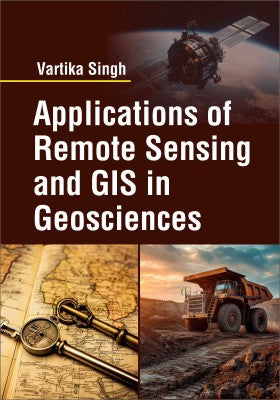
Remote Sensing and Geographic Information Systems (GIS) play a crucial role in advancing our understanding of the Earth's geosciences. These technologies provide valuable tools for data acquisition, analysis, visualization, and decision-making in various geoscientific disciplines. The application of remote sensing and GIS in geosciences has revolutionized the way we study and manage natural resources, monitor environmental changes, and assess hazards. Remote sensing involves the collection of data about the Earth's surface and atmosphere using sensors mounted on satellites, aircraft, or drones. These sensors capture images and other measurements in different spectral bands, ranging from visible light to microwave radiation. This data helps scientists study a wide range of geoscience phenomena, including land cover and land use, vegetation dynamics, oceanography, atmospheric conditions, and geological features. GIS, on the other hand, is a powerful tool for capturing, storing, analyzing, and displaying geospatial data. It combines maps, satellite imagery, and various data layers to create a digital representation of the Earth's surface. GIS enables geoscientists to integrate different datasets, perform spatial analysis, and generate models and visualizations that aid in decision-making.
Pages : 152
Year of Publication : 2025
Language : English
Binding : Hardback
Remote Sensing and Geographic Information Systems (GIS) play a crucial role in advancing our understanding of the Earth's geosciences. These technologies provide valuable tools for data acquisition, analysis, visualization, and decision-making in various geoscientific disciplines. The application of remote sensing and GIS in geosciences has revolutionized the way we study and manage natural resources, monitor environmental changes, and assess hazards. Remote sensing involves the collection of data about the Earth's surface and atmosphere using sensors mounted on satellites, aircraft, or drones. These sensors capture images and other measurements in different spectral bands, ranging from visible light to microwave radiation. This data helps scientists study a wide range of geoscience phenomena, including land cover and land use, vegetation dynamics, oceanography, atmospheric conditions, and geological features. GIS, on the other hand, is a powerful tool for capturing, storing, analyzing, and displaying geospatial data. It combines maps, satellite imagery, and various data layers to create a digital representation of the Earth's surface. GIS enables geoscientists to integrate different datasets, perform spatial analysis, and generate models and visualizations that aid in decision-making.
Share