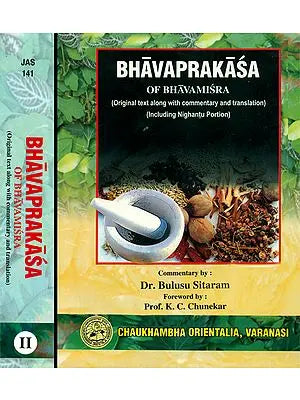
Bhavaprakasa of Bhavamisra: Original Text Along with Commentary and Translation (Set of 2 Volumes)
Bhavaprakasa of Bhavamisra: Original Text Along with Commentary and Translation (Set of 2 Volumes)
Hardcover
Couldn't load pickup availability
DETAILS :
- Author : Foreword by: Prof. K. C. Chuneker Dr. Bulusu Sitaram
- Publisher : Chaukhambha Orientalia, Varanasi
- Publication date : January 1, 2006
- Edition : 2006th
- Language : English
- Weight : 2600g
ABOUT THE BOOK
The Bhavaprakasa of Bhavamisra is a landmark treatise in the history of Ayurveda, marking the transition between the classical and medieval periods of Indian medicine. This edition, featuring the original Sanskrit text alongside a comprehensive commentary and English translation, is highly valued for including the Nighantu (lexicon) portion.
Written in the 16th century, the Bhavaprakasa is one of the "Laghu Trayi" (The Lesser Triad) of Ayurveda. It is uniquely famous for introducing new medicinal plants, exotic drugs (like Chobachini), and describing new diseases such as Phiranga Roga (Syphilis) for the first time in Ayurvedic literature. The Nighantu section provides an exhaustive classification of herbs, minerals, and animal products, detailing their properties (Guna), tastes (Rasa), and therapeutic effects (Virya/Vipaka).
ABOUT THE AUTHORS & COMMENTATORS
Bhavamisra: A brilliant physician of the 16th century who hailed from Magadha (modern Bihar). He was a visionary who synthesized the wisdom of the Charaka Samhita and Sushruta Samhita while adding his own observations on the evolution of diseases and treatments.
Dr. Bulusu Sitaram: A renowned scholar of Ayurveda and Dravyaguna (Pharmacology), Dr. Sitaram’s translation is celebrated for its clarity and technical accuracy, making ancient Sanskrit medical concepts understandable to modern practitioners.
Prof. K. C. Chunekar: A legendary figure in the field of Ayurvedic botany and Dravyaguna, his foreword and scholarly input lend immense authority to this edition, particularly regarding the identification of medicinal plants.
Share