1
/
of
1
Corn Silk: Sustainable Health and Agribusiness Opportunities
Corn Silk: Sustainable Health and Agribusiness Opportunities
Regular price
$59.52 USD
Regular price
$99.20 USD
Sale price
$59.52 USD
Unit price
/
per
Couldn't load pickup availability
Author : Rita Singh Raghuvanshi, Reetika Bhatt and Apurva
Pages : 252
Year of Publication : 2026
Language : English
Binding : Hardback
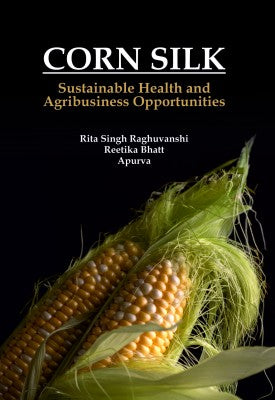
Corn Silk: Sustainable Health and Agribusiness Opportunities explores the untapped potential of corn silk, a by- product of maize cultivation that is traditionally discarded despite its long-standing use in indigenous and traditional health systems. The book brings attention to corn silk as a meaningful bioresource that can contribute simultaneously to human health, environmental sustainability, and rural livelihood enhancement. By moving beyond its conventional perception as agricultural waste, the book reframes corn silk as a resource with scientific, nutritional, and economic significance. Grounded in decades of academic research, laboratory studies, and field-level experience, the book presents a comprehensive account of the biological role of corn silk, its nutritional profile, and its rich composition of bioactive compounds. It explains the physiological relevance of these components in a clear, evidence-based manner while also addressing practical considerations such as harvesting methods, processing techniques, preservation strategies, and pathways for product development. This balanced treatment ensures that scientific knowledge is closely linked with real-world applicability. A key strength of the book is its integrated and interdisciplinary approach. In addition to health and nutrition aspects, it examines agribusiness opportunities, market potential, value chain development, financial planning, regulatory requirements, and policy frameworks. This structure reflects the practical reality that sustainable utilization of agricultural by-products requires coordination across science, enterprise, and governance. By presenting these dimensions together, the book supports informed decision-making for researchers, entrepreneurs, extension professionals, and policymakers. Written in a style that balances scientific rigor with clarity, the book is intended for a diverse readership. Students and researchers gain a strong evidence-based foundation, while practitioners, entrepreneurs, and extension workers find practical insights for implementation and scaling. Ultimately, the book encourages a shift in perspective, advocating for corn silk to be recognized not as waste, but as a versatile resource capable of contributing to improved health outcomes, resilient rural economies, and more sustainable food systems.
Pages : 252
Year of Publication : 2026
Language : English
Binding : Hardback
Corn Silk: Sustainable Health and Agribusiness Opportunities explores the untapped potential of corn silk, a by- product of maize cultivation that is traditionally discarded despite its long-standing use in indigenous and traditional health systems. The book brings attention to corn silk as a meaningful bioresource that can contribute simultaneously to human health, environmental sustainability, and rural livelihood enhancement. By moving beyond its conventional perception as agricultural waste, the book reframes corn silk as a resource with scientific, nutritional, and economic significance. Grounded in decades of academic research, laboratory studies, and field-level experience, the book presents a comprehensive account of the biological role of corn silk, its nutritional profile, and its rich composition of bioactive compounds. It explains the physiological relevance of these components in a clear, evidence-based manner while also addressing practical considerations such as harvesting methods, processing techniques, preservation strategies, and pathways for product development. This balanced treatment ensures that scientific knowledge is closely linked with real-world applicability. A key strength of the book is its integrated and interdisciplinary approach. In addition to health and nutrition aspects, it examines agribusiness opportunities, market potential, value chain development, financial planning, regulatory requirements, and policy frameworks. This structure reflects the practical reality that sustainable utilization of agricultural by-products requires coordination across science, enterprise, and governance. By presenting these dimensions together, the book supports informed decision-making for researchers, entrepreneurs, extension professionals, and policymakers. Written in a style that balances scientific rigor with clarity, the book is intended for a diverse readership. Students and researchers gain a strong evidence-based foundation, while practitioners, entrepreneurs, and extension workers find practical insights for implementation and scaling. Ultimately, the book encourages a shift in perspective, advocating for corn silk to be recognized not as waste, but as a versatile resource capable of contributing to improved health outcomes, resilient rural economies, and more sustainable food systems.
Share