1
/
of
1
Drying Technologies for Foods: Fundamentals & Applications: Part III
Drying Technologies for Foods: Fundamentals & Applications: Part III
Regular price
$142.26 USD
Regular price
$237.10 USD
Sale price
$142.26 USD
Unit price
/
per
Couldn't load pickup availability
Author : Nema, Prabhat, Barjindar Pal Kaur and Arun Majumdar
Pages : 378
Year of Publication : 2018
Language : English
Binding : Hardback
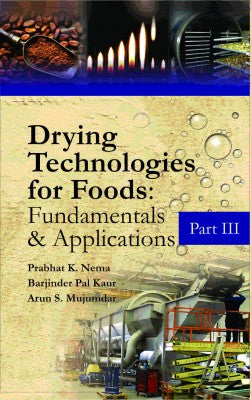
Drying is an essential process in the food industry for the preservation and processing of food products. The industry is always seeking cost-effective and energy-efficient drying techniques to achieve commercial success and meet the demand for high-quality dried food products. Despite the extensive technical literature available on the drying of foods, it remains challenging for scientists and engineers to enhance existing drying systems and improve the quality of the products. The book, consisting of 14 chapters, covers a range of drying techniques, including freeze drying, atmospheric freeze drying, swell drying, multi-flash drying, electro-hydrodynamic drying, pulse combustion drying, foam mat drying, and ultrasound-assisted drying, as well as fluidized bed drying. Additionally, the book addresses commodity-specific drying, such as mushroom drying and the drying and roasting of cocoa and coffee beans. The book also covers topics such as the degradation mechanism and kinetics of vitamin C in fruits and vegetables, kinetics modeling of the drying process for the recovery of bioactive compounds, and energy calculation procedures for dryers, which can help improve the efficiency of the drying process.
Pages : 378
Year of Publication : 2018
Language : English
Binding : Hardback
Drying is an essential process in the food industry for the preservation and processing of food products. The industry is always seeking cost-effective and energy-efficient drying techniques to achieve commercial success and meet the demand for high-quality dried food products. Despite the extensive technical literature available on the drying of foods, it remains challenging for scientists and engineers to enhance existing drying systems and improve the quality of the products. The book, consisting of 14 chapters, covers a range of drying techniques, including freeze drying, atmospheric freeze drying, swell drying, multi-flash drying, electro-hydrodynamic drying, pulse combustion drying, foam mat drying, and ultrasound-assisted drying, as well as fluidized bed drying. Additionally, the book addresses commodity-specific drying, such as mushroom drying and the drying and roasting of cocoa and coffee beans. The book also covers topics such as the degradation mechanism and kinetics of vitamin C in fruits and vegetables, kinetics modeling of the drying process for the recovery of bioactive compounds, and energy calculation procedures for dryers, which can help improve the efficiency of the drying process.
Share