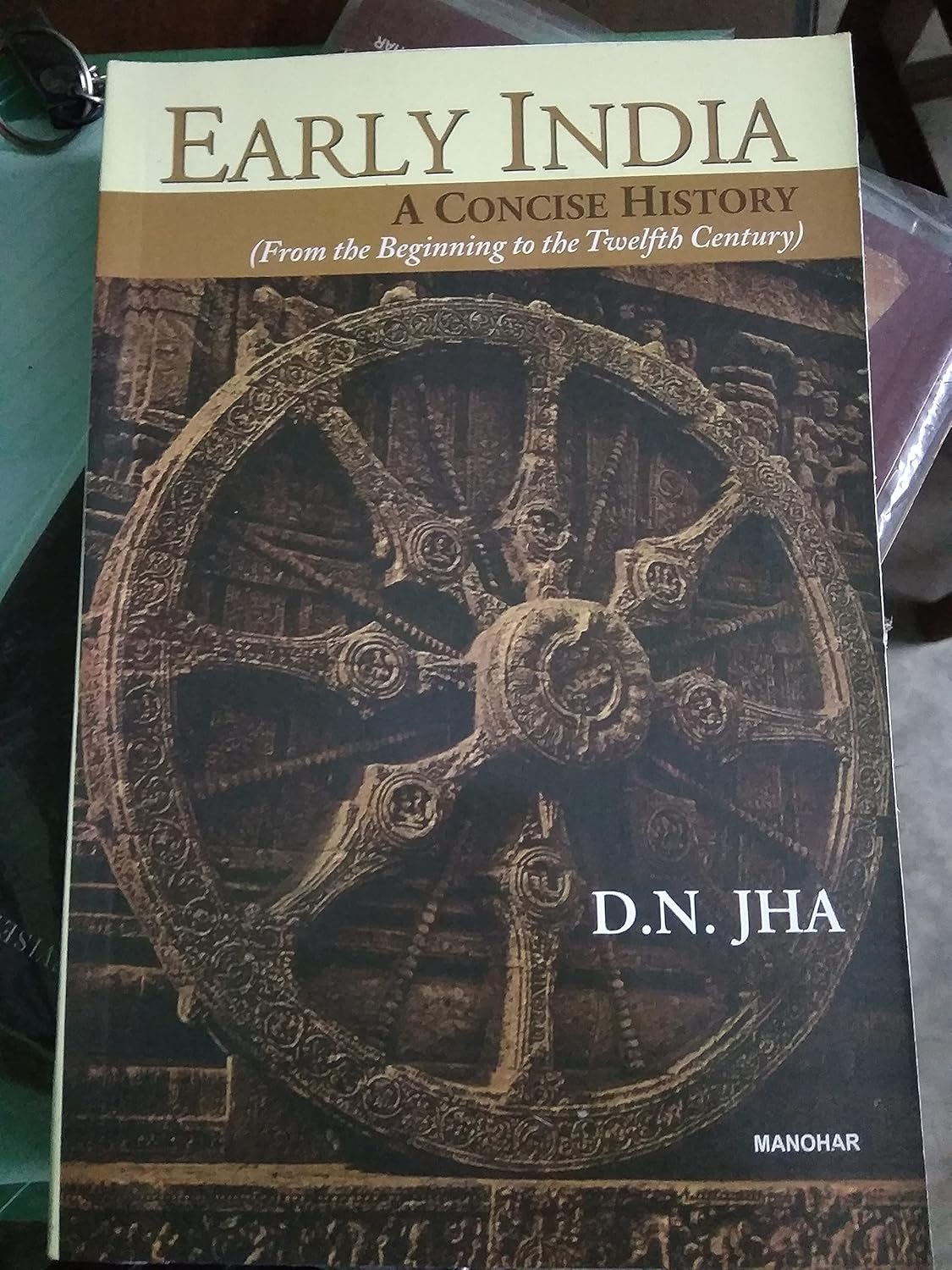
Early India: A Concise History
Early India: A Concise History
Paperback
Couldn't load pickup availability
DETAILS :
- Author : D. N. Jha
- Publisher : Manohar Publishers and Distributors
- Publication date : 1 December 2005
- Language : English
- Paperback : 269 pages
- ISBN-10 : 8173045879
- ISBN-13 : 978-8173045875
- Item Weight : 400 g
ABOUT THE BOOK
Early India: A Concise History, authored by the highly influential historian Prof. D. N. Jha and published in 2004 by Manohar Publishers and Distributors, is an authoritative, analytical overview of the major socio-economic and political transitions in Indian history. Spanning from prehistory through the ancient period and into the early medieval era, this text offers an accessible yet deeply critical entry point into the structural foundations of early Indian civilization.
Jha’s primary objective in this work is to challenge dominant, romanticized historical narratives by analyzing the past through a materialist, evidence-based lens. The text systematically traces the evolution of early Indian society, evaluating the technological breakthroughs of the Harappan civilization, the geographic origins and pastoral lifestyle of the Vedic Aryans, and the gradual solidification of the rigid caste system (varna and jati). The narrative tracks the subsequent rise of regional states (Mahajanapadas) and the complex administrative consolidation that culminated in the expansive Maurya Empire.
A central pillar of the book is its vigorous deconstruction of popular historical myths, specifically targeting the conventional nationalistic view that characterizes the Gupta Empire as the unblemished "Golden Age" of Indian history. Jha presents data demonstrating that this period actually initiated a slow economic fragmentation, marked by a decline in long-distance trade, the decay of urban centers, and the rise of localized land grants that transformed India from a pre-feudal to a structural feudal economy. By investigating the everyday realities of class, labor, and changing gender roles, the text highlights the constant interplay of change and continuity, providing students and civil services aspirants with a clear alternative to colonial or communal interpretations of India's past.
ABOUT THE AUTHOR
Dr. Dwijendra Narayan Jha (1940–2021), universally known as D. N. Jha, was a towering intellectual, author, and Professor of History at the University of Delhi, specializing in ancient and medieval economic history. Over a career spanning more than three decades, he established himself as a prominent pioneer of the materialist school of Indian historiography, working closely alongside other legendary scholars like R. S. Sharma to emphasize socio-economic structures over royal genealogies or military folklore.
Professor Jha was a fearless and highly vocal advocate for professional, scientific history-writing, frequently using his academic platform to stand against the communal distortion and political manipulation of ancient texts. His landmark and highly controversial books, such as The Myth of the Holy Cow, drew directly from the Vedas, Upanishads, and early medical treatises like the Charaka Samhita to contextualize ancient dietary habits, proving that cattle were routinely offered in sacrifices and consumed in early India. A former section president of the Indian History Congress and an author of foundational textbooks for the National Council of Educational Research and Training (NCERT), Jha’s writing is celebrated for its absolute fearlessness, logical argumentation, and sharp, uncompromising prose style.
Share