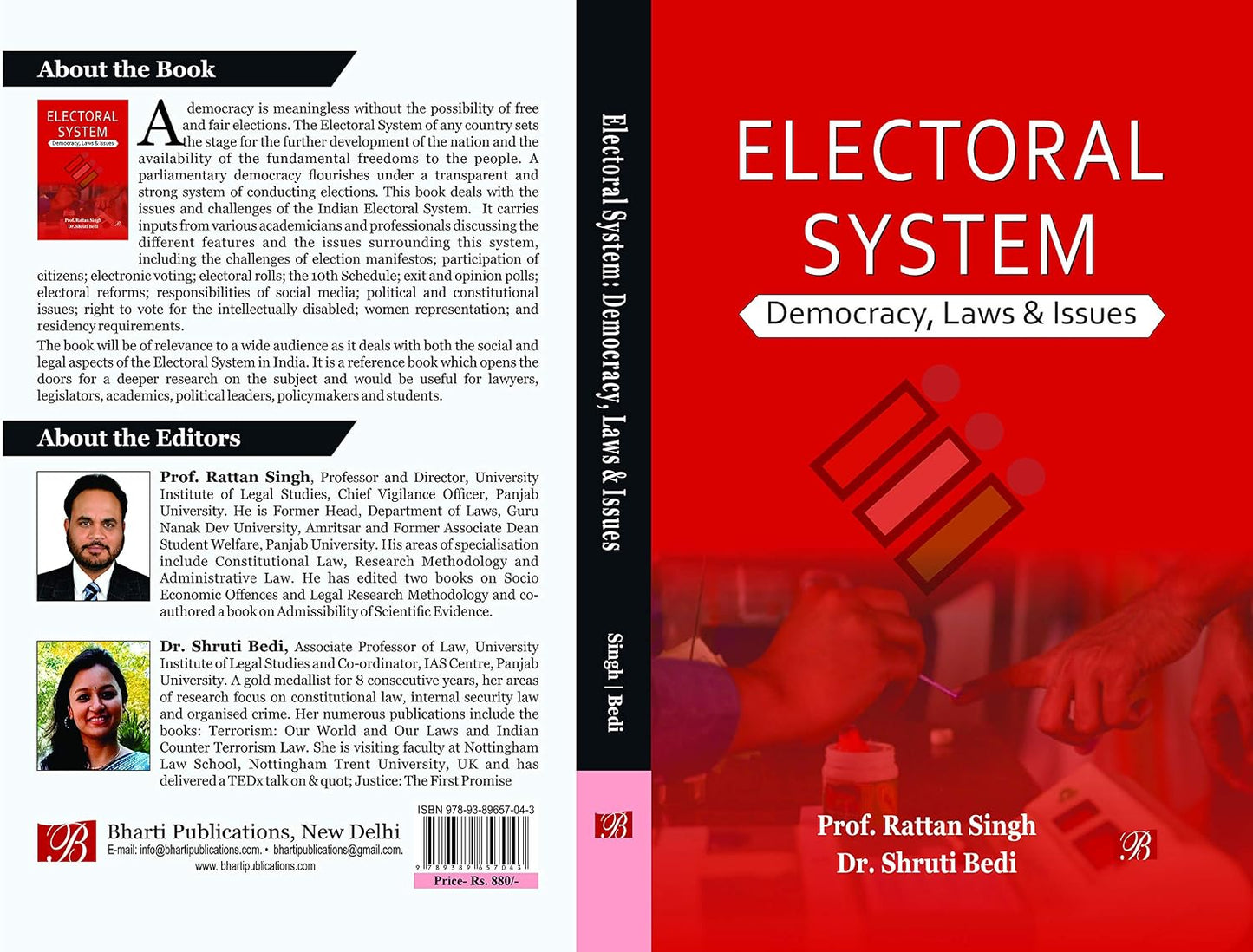
Electoral System: Democracy, Laws & Issue
Electoral System: Democracy, Laws & Issue
Hardcover
Couldn't load pickup availability
DETAILS :
- Author: Prof. Rattan Singh , Dr. Shruti Bedi
- Publisher: Bharti Publications
- Publication date: 1 January 2019
- Language: English
- ISBN-10: 9389657040
- ISBN-13: 978-9389657043
- Item Weight: 450 g
ABOUT THE BOOK
Electoral System: Democracy, Laws & Issues, co-authored by the prominent legal scholars Prof. Rattan Singh and Dr. Shruti Bedi, is an authoritative reference volume and academic critique focusing on the constitutional, statutory, and operational frameworks of the Indian electoral machinery. Published by Bharti Publications, this comprehensive text is meticulously developed under the aegis of the Centre for Constitution and Public Policy at the University Institute of Legal Studies (UILS), Panjab University. The core philosophy of this work centers on the premise that a clean, transparent, and legally sound electoral system is the ultimate lifeblood of a representative democracy. The authors analyze elections not just as periodic political events, but as highly complex legal procedures that require constant statutory oversight, judicial interpretation, and structural reforms to truly safeguard the mandate of the citizenry.
The volume is structurally organized into a series of deeply analytical research papers and thematic essays that transition from foundational constitutional rights to contemporary technological and administrative challenges. It begins with an exhaustive evaluation of the right to vote, treating it as a fundamental pillar of democratic citizenship, and outlines the constitutional jurisdiction of the Election Commission of India under Article 324. The middle sections dive deep into the specific legislative acts governing the democratic process, providing sharp commentaries on the Representation of the People Act, 1951, rules regarding the disqualification of representatives, and laws tackling political defection. A significant portion of the text is dedicated to modern systemic vulnerabilities, exploring the legality of political funding, the persistent issue of criminalization in politics, and the technical safeguards surrounding Electronic Voting Machines (EVMs) and Voter Verifiable Paper Audit Trails (VVPATs). By balancing theoretical jurisprudence with actual landmark judgments from the Supreme Court of India, the book outlines a progressive framework for sweeping electoral reforms.
ABOUT THE AUTHOR
The intellectual collaboration behind this volume brings together two elite legal minds from Panjab University, Chandigarh. Prof. (Dr.) Rattan Singh is a distinguished Professor of Law, Director of the University Institute of Legal Studies, and a widely recognized authority on constitutional law and criminal justice systems. Dr. Shruti Bedi is an Associate Professor at UILS, an expert chronicler of constitutional mandates and national security laws, and serves as the Co-ordinator of the IAS Centre at Panjab University, bringing deep competitive and administrative insights to her academic writing.
The collective authorial and analytical style of Prof. Singh and Dr. Bedi is characterized by strict legal precision, rigorous statutory cross-referencing, and a supportive, peer-to-peer scholarly tone. Writing with the balanced objectivity of veteran legal educators who closely monitor institutional policy changes, they avoid casual political commentary in favor of explicit constitutional provisions, commission reports, and case law analysis. By translating dense, complex administrative rules and judicial doctrines into accessible, structured legal arguments, their collective literature serves as an indispensable reference standard for university libraries, research scholars, judicial officers, civil services aspirants, and policymakers specializing in constitutional governance.
Share