1
/
of
1
Engineering Properties of Agricultural Produce
Engineering Properties of Agricultural Produce
Regular price
$92.62 USD
Regular price
$154.37 USD
Sale price
$92.62 USD
Unit price
/
per
Couldn't load pickup availability
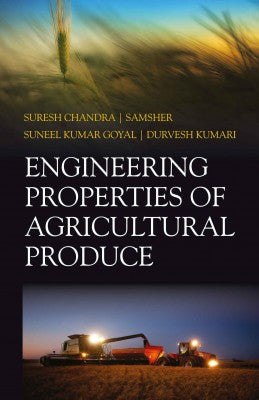
Author : Suresh Chandra, Samsher, Suneel Kumar Goyal & Durvesh Kumari
Pages : 242
Year of Publication : 2020
Language : English
Binding : Hardback
In any agricultural country, a large quantity of various types of agricultural commodities are produced, and to handle such quantities during harvest, post-harvest processing, and transportation, various types of equipment are required. In designing specific equipment or determining the behavior of the product during its handling, physical properties such as size, shape, surface area, volume, and density, as well as porosity, play a crucial role. Based on the physical properties of seeds, such as size, shape, and specific gravity, various types of cleaning, grading, and separation equipment are designed. This book aims to provide a fundamental understanding of the engineering properties of agricultural produce and combines engineering knowledge with such properties. Each chapter in the book will assist students in understanding the relationship between engineering properties of raw, semi-finished, and processed food and obtaining products with the desired shelf-life and quality. The book discusses basic definitions, principles of engineering properties, and their measurement methods, along with research findings. It will serve as a valuable resource for students' self-study and to gain information on how to analyze experimental data to generate practical information. Additionally, it will benefit students who deal with engineering properties in their research, as it explains in detail the methods to measure these properties.
Pages : 242
Year of Publication : 2020
Language : English
Binding : Hardback
In any agricultural country, a large quantity of various types of agricultural commodities are produced, and to handle such quantities during harvest, post-harvest processing, and transportation, various types of equipment are required. In designing specific equipment or determining the behavior of the product during its handling, physical properties such as size, shape, surface area, volume, and density, as well as porosity, play a crucial role. Based on the physical properties of seeds, such as size, shape, and specific gravity, various types of cleaning, grading, and separation equipment are designed. This book aims to provide a fundamental understanding of the engineering properties of agricultural produce and combines engineering knowledge with such properties. Each chapter in the book will assist students in understanding the relationship between engineering properties of raw, semi-finished, and processed food and obtaining products with the desired shelf-life and quality. The book discusses basic definitions, principles of engineering properties, and their measurement methods, along with research findings. It will serve as a valuable resource for students' self-study and to gain information on how to analyze experimental data to generate practical information. Additionally, it will benefit students who deal with engineering properties in their research, as it explains in detail the methods to measure these properties.
Share