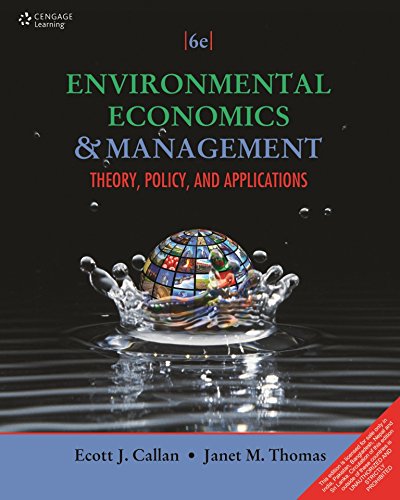
Environmental Economics and Management: Theory, Policy and Applications
Environmental Economics and Management: Theory, Policy and Applications
Paperback
Couldn't load pickup availability
DETAILS :
- Author: Scott J. Callan
- Publisher: South Western
- Publication date: 1 April 2015
- Edition: 6th
- Language: English
- Print length: 624 pages
- ISBN-10: 8131527646
- ISBN-13: 978-8131527641
- Item Weight: 1000 g
ABOUT THE BOOK
Environmental Economics and Management: Theory, Policy, and Applications, co-authored by the elite environmental economics scholars Dr. Scott J. Callan and Dr. Janet M. Thomas, is an authoritative, market-leading textbook that bridges advanced economic theory with corporate and public policy management. Published by Cengage Learning (and internationally under South-Western Publishing), this comprehensive textbook is a cornerstone resource for economics, environmental studies, and MBA programs globally. The core philosophy of this text centers on structural integration—proving that environmental preservation and economic growth are not mutually exclusive, but rather deeply interdependent systems that require market-based solutions, rigorous cost-benefit modeling, and strategic regulatory design.
The volume is structurally organized into distinct, highly systematic sections that blend mathematical microeconomic foundations with real-world applications. It begins by establishing the fundamental relationship between economic activity and the environment, introducing the circular flow model and deconstructing market failures like negative externalities and public goods. The middle modules provide an exhaustive analytical breakdown of analytical tools and policy strategies:
- Command-and-Control vs. Market-Based Policy: Comparing rigid emission standards against flexible, incentive-based tools such as pollution charges, environmental subsidies, and cap-and-trade deposit-refund systems.
- Environmental Valuation Methods: Evaluating physical and behavioral modeling structures including the Travel Cost Method, Hedonic Pricing Method, and Contingent Valuation Method to assign monetary value to non-market environmental goods.
- Cost-Benefit Analysis (CBA): Mapping out discounting mechanisms to assess the present value of net social benefits ($PVNB$) for long-term climate initiatives.
The final third of the textbook applies these analytical frameworks to pressing global and regional environmental crises. It dedicates comprehensive chapters to mobile and stationary air pollution sources (such as the Clean Air Act mandates), water quality management (addressing point and non-point source pollution under the Clean Water Act), hazardous waste remediation, and global existential challenges like ozone depletion and climate change mitigation strategies.
ABOUT THE AUTHOR
Dr. Scott J. Callan is an elite Professor of Economics at Bentley University, Waltham, Massachusetts, where he has taught environmental economics, microeconomics, and applied statistics for decades. Alongside his long-time co-author, Dr. Janet M. Thomas (also a Professor of Economics at Bentley University), his extensive academic research focuses heavily on empirical models of solid waste management, recycling behaviors, and the financial impact of environmental regulations on corporate performance.
The collective authorial and pedagogical style of this team is exceptionally clear, precise, and modular. Writing with the directness of expert policy consultants, they cut through dense mathematical abstractions by immediately matching microeconomic formulas with concrete case studies, corporate profiles, and real-world legislative debates. Complex market structures, pollution abatement curves, and equilibrium shifts are systematically illustrated using clean graphs, scannable summary boxes, and tiered end-of-chapter exercises that range from basic prose discussions to advanced algebraic optimizations. By balancing deep theoretical mechanics with practical managerial insights, their literature remains an irreplaceable international benchmark for students, corporate sustainability officers, and public policy analysts worldwide.
Share