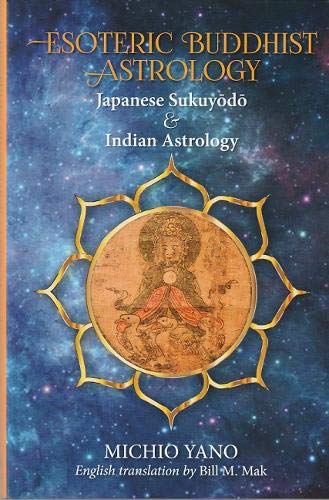
Esoteric Buddhist Astrology: Japanese Sukuyodo and Indian Astrology
Esoteric Buddhist Astrology: Japanese Sukuyodo and Indian Astrology
Paperback
Couldn't load pickup availability
DETAILS :
- Author: Michio Yano
- Translator: Bill M. Mak
- Publisher: Aditya Prakashan, New Delhi
- Publication date: January 1, 2019
- Language: English
- ISBN-10: 8193462173
- ISBN-13: 978-8193462171
- Item Weight: 550 G
ABOUT THE BOOK
Esoteric Buddhist Astrology: Japanese Sukuyodo and Indian Astrology, authored by the world-renowned historian of exact sciences Prof. Michio Yano and translated into English by Dr. Bill M. Mak, is a groundbreaking philological and historical monograph. Published by Aditya Prakashan, this specialized text provides an exhaustive overview of how ancient astral sciences traveled across cultures. The core philosophy of this work centers on tracing the complex transmission of Mesopotamian, Hellenistic, and Vedic Indian astrological frameworks into medieval East Asia via Buddhist channels. Yano demonstrates that Japanese Sukuyōdō (the "Way of Constellations and Planets") is not an isolated Japanese invention, but an intriguing, highly sophisticated amalgamation of Indian lunar astrology and Chinese observational astronomy.
The monograph is structurally organized into meticulous comparative chapters that decode ancient manuscripts and translation lineages. It primarily focuses on the Xiuyao jing (The Constellation and Planet Sutra), an 8th-century classical Chinese text attributed to the legendary Indian Tantric master Amoghavajra (Bukong). Yano exercises exceptional textual rigor to analyze how the 27 or 28 Indian nakṣatras (lunar mansions), the tithis (lunar days), the pakṣas (lunar fortnights), and the seven-day Western planetary week were adapted into Chinese calendrical science and eventually transmitted to Japan by returning 9th-century monks. The second half of the book breaks down the mathematical and astronomical models found in the Qiyao rangzai jue (The Secret of Seven-Planet Disaster Prevention), tracking the enigmatic introduction of Ketu (re-interpreted here as the lunar apogee) and the development of horoscopy within esoteric Mikkyō Buddhist rituals (Shingon and Tendai schools) to determine auspicious timings for making sacred mandalas.
ABOUT THE AUTHOR
Dr. Michio Yano is an elite Japanese academician, indologist, and Professor Emeritus at Kyoto Sangyo University. As a former member of the Science Council of Japan and a member of the International Academy of History of Science, he is globally celebrated as one of the ultimate authorities on the history of Indian traditional astronomy, Sanskrit mathematics, and cross-cultural astral transmissions. Dr. Bill M. Mak is a premier scholar, researcher, and linguist whose masterful English translation captures the precise technical terminology, dense textual notes, and historical nuances of Yano's original 1986 and revised 2013 Japanese editions.
The collective analytical style of Yano and Mak is extraordinarily precise, academic, and deeply rooted in rigorous textual philology. Writing with the clarity of a veteran mathematical historian who values scientific accuracy over unverified mystical lore, Yano explains complex celestial movements, planetary ephemerides, and ancient calendar systems with absolute lucidity. By balancing historical anecdotes of medieval monks with structured comparative charts and rigorous translation tables, his collective literature remains the definitive international reference standard for scholars of East Asian history, Buddhist studies, archaeoastronomy, and comparative religion.
Share