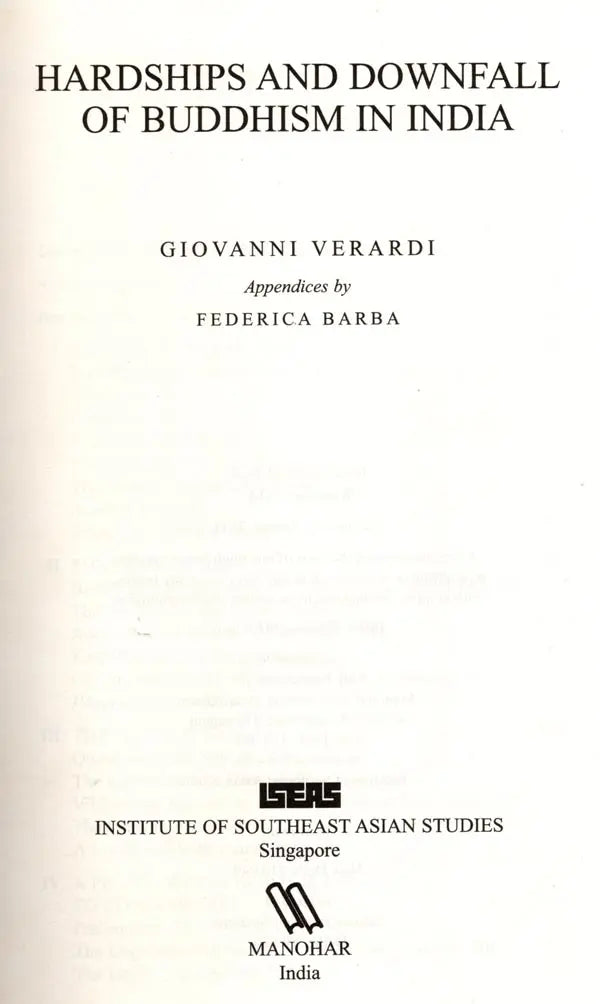
Hardships and Downfall of Buddhism in India
Hardships and Downfall of Buddhism in India
Hardcover
Couldn't load pickup availability
DETAILS :
- Author : Giovanni Verardi
- Publisher : Manohar Publishers And Distributors
- Publication date :29 August 2011
- Language : English
- Hardcover : 523 pages
- ISBN-10 : 8173049289
- ISBN-13 : 9788173049286
- Item Weight : 850 g
ABOUT THE BOOK
This book is not so much about Buddhism as about Indian History a general knowledge of which is taken for granted. It is a kind of advanced history of India aimed at discussing the mechanisms that started to set in motion the events that with increasing force characterized the Indian middle age until the thirteenth century and at examining the often elusive or disregarded evidence that document the weakening and collapse of Buddhism. I do not share the inclusive paradigm that assumes that in ancient India for all the recognized differences there was we speak here of the structured systems a single development model broadly shared by all the forces in the field. I see India as the only civilization of the ancient world that generated two opposing models of social and economic relations that coexisted for a long time in conflict whatever that attempts to reduce or mask the incompatibilities. Far from being a history with a low level of conflict it was highly confrontational. Despite the widespread tendency to underestimate historical discontinuities and create inclusive paradigms it is possible to deconstruct Indian history entering it through the visible fractures that mark its surface. These fractures are comparable to those encountered in volcanic souls where fumaroles and sulphurous deposits make one understand that an explosive magma is lying beneath. In many cases have unexpectedly widened allowing a vision that if not unprecedented is nevertheless note worthy.
The issues raised in this book are numerous but two emerge. I think with particular clarity. The first is that whereas the idea of state and society the Buddhists had in mind was compatible with the extremely varied people inhabiting the subcontinent, the Brahmanical model implied their forced incorporation into the well guarded perimeter of an agrarian society. It was not just a state society that especially from the Gupta Period onwards started being established in vast portions of India but a varna society and this made the difference. Its establishment caused the arising of an extremely strong opposition, generally underestimated by historians. The varna state was opposed not only by the natives who, against their will, saw themselves downgraded to the lower peasantry ranks, but also by the Buddhist brahmanas who were in favour of a trading society less dependent on agricultural resources, and consequently less bound to the strict rules of varna and jãti. The second point is that the imposition of the rules of the varna state implied much violence. This appears most clearly in the non-brahmanised regions of central and northeastern India where, from the eighth century onwards, the followers of the Vajrayana decided to play the card of social revolt, but is already clear from the very beginning of the process: hence the central position that Gupta policy is given in this book. Intimidation and violence also caused a number of transformations in the religion of Dharma, where, rather early, a section of the ramana-s started organizing themselves according to a community model paralleling the Brahmanical priesthood and lifestyle.
ABOUT THE AUTHOR
As a member of ISIAQ Rome Giovanni Verrardi has carried out excavations in Afghanistan (Ghazni) Nepal (In Kathmandu and at the Asokan Site of Gotihawa) and China (Lyoyang) as well as extensive surveys and research work in India and Pakistan. He has been professor of Indian Archaeology and Archaeology of Central Asia at the Universita L Orientale Naples.
Share