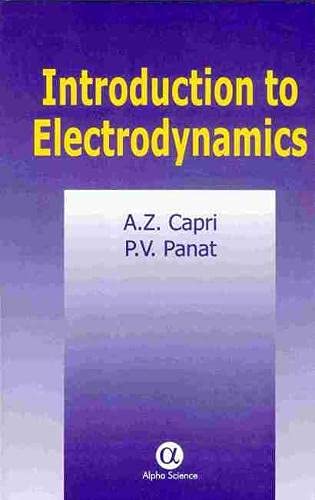
Introduction to Electrodynamics
Introduction to Electrodynamics
Paperback
Couldn't load pickup availability
DETAILS :
- Author : P.V. Panat , A.Z. Capri
- Publisher : Narosa Publishing House
- Publication date : 30 March 2000
- Language : English
- Paperback : 482 pages
- ISBN-10 : 8173193290
- ISBN-13 : 978-8173193293
- Item Weight : 750 g
ABOUT THE BOOK
Introduction to Electrodynamics is a rigorous and mathematically sophisticated textbook designed for advanced undergraduate and early graduate students of physics. While many students are familiar with Griffith’s introductory approach, this work by A.Z. Capri and P.V. Panat is known for providing a more formal and detailed bridge into the complexities of electromagnetic theory.
The book excels in its systematic development of Maxwell’s equations, starting from the experimental foundations of electrostatics and magnetostatics. It offers an in-depth treatment of:
- Mathematical Tools: A heavy emphasis on vector calculus and boundary-value problems.
- Electromagnetic Waves: Detailed analysis of propagation in conducting and non-conducting media, including waveguides and cavity resonators.
- Relativistic Electrodynamics: A standout feature where the authors demonstrate the beautiful symmetry between electricity and magnetism through the lens of special relativity.
- Radiation Theory: Comprehensive derivations of Liénard-Wiechert potentials and radiation from moving charges.
The text is peppered with challenging problems that are designed to hone a student's analytical skills, making it a favorite for those preparing for competitive research-level examinations.
ABOUT THE AUTHORS
A.Z. Capri is a respected theoretical physicist and Professor Emeritus at the University of Alberta. He is well-regarded for his work in quantum field theory and has authored several influential textbooks that are praised for their logical flow and mathematical precision.
P.V. Panat was a distinguished Professor of Physics at the University of Pune. He was a beloved educator in India, known for his ability to simplify abstract physical concepts without sacrificing the mathematical rigor required for higher physics. His collaboration with Capri brought together a global perspective on physics education, blending the Western analytical tradition with the strong pedagogical focus found in Indian academia. Together, they created a text that remains a staple for serious students of physics across the globe.
Share