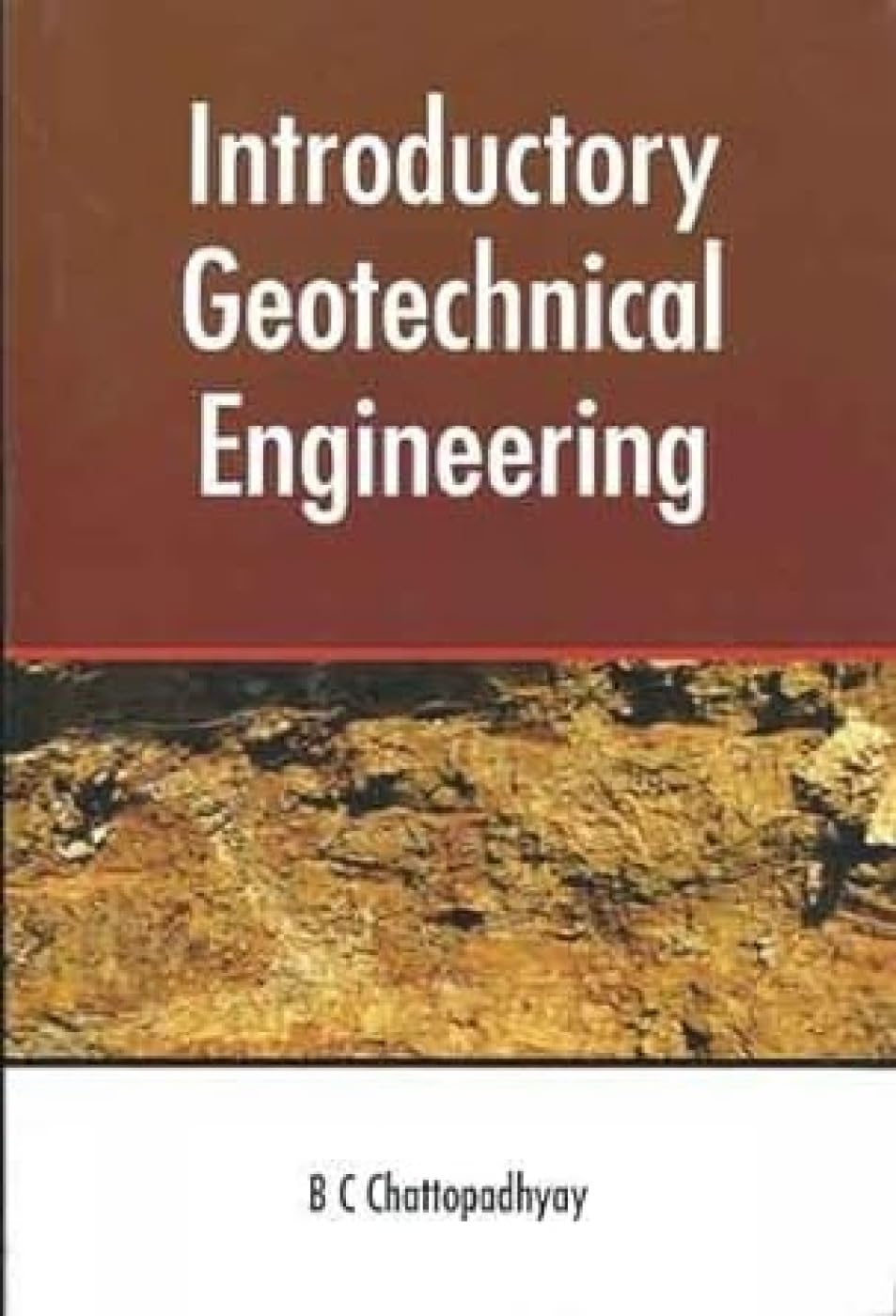
Introductory Geotechnical Engineering
Introductory Geotechnical Engineering
Paperback
Couldn't load pickup availability
DETAILS :
- Author: B.C. Chattopadhyay
- Publisher: Vikas Publishing House
- Publication date: 30 April 2010
- Edition: First Edition
- Language: English
- Print length: 219 pages
- ISBN: 9788189766344
- Item Weight: 350 g
ABOUT THE BOOK
Introductory Geotechnical Engineering, authored by the highly distinguished engineering educator Dr. B.C. Chattopadhyay, is a comprehensive, conceptually sound textbook engineered primarily for undergraduate civil engineering students. Published by Vitasta Publishing, this seminal text is tailored to align precisely with the core geotechnical and foundation engineering curricula of major technical universities. The core philosophy of this text is to dismantle the complexities of soil mechanics into highly simplified, logically progressive units. Chattopadhyay presents soil not merely as a passive static mass, but as a complex, variable multiphase engineering material whose interaction with environmental and mechanical stresses demands absolute mathematical and analytical precision.
The textbook is structurally organized into a systematic framework that balances foundational theories of soil physics with structural application. It opens with an essential introduction to the genesis of soils, their geological origins, and standard weight-volume relationships. The early chapters establish a firm understanding of soil classifications, consistency limits, and permeability characteristics. The narrative then progresses into advanced soil mechanics, offering exhaustive analyses of effective stress concepts, seepage theory, flow nets, and subsurface soil compaction. Crucial computational chapters focus heavily on stress distribution in soil mass, one-dimensional consolidation theory, and the shear strength parameters of both cohesive and cohesionless soils. The concluding sections of the book transition seamlessly into practical engineering, covering lateral earth pressure theories, the stability of slopes, and structural foundation designs, while ending with an invaluable modern overview of geotechnical earthquake engineering for disaster mitigation.
ABOUT THE AUTHOR
Dr. B.C. Chattopadhyay is an elite academic luminary, researcher, and veteran consultant in civil engineering who possesses over four decades of foundational teaching experience at both undergraduate and postgraduate levels. He earned his Ph.D. from the prestigious Indian Institute of Technology (IIT) Kharagpur, where his breakthrough research won him the prestigious Leonard's Prize from the Indian Geotechnical Society. Throughout his long academic career, he has served as the Head of the Civil Engineering Department at Bengal Engineering and Science University (BESU, Shibpur), as well as the Director for the School of Disaster Mitigation Engineering.
Dr. Chattopadhyay’s pedagogical and authorial style is characterized by extreme lucidity, systematic problem-solving methods, and a supportive, student-centric focus. Writing as a deeply compassionate academic mentor, he designs his texts specifically to help students bridge the gap between classroom theory and the demanding, real-world analytical problems found in competitive professional examinations like GATE and civil services. By backing up every theoretical engineering concept with an extensive library of step-by-step solved mathematical examples and clear schematic diagrams, his literature has established itself as an indispensable reference standard for civil engineering institutions, diploma students, and practicing field engineers alike.
Share