1
/
of
1
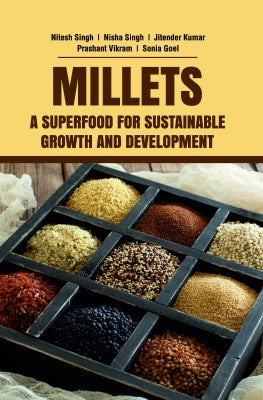
Millets: A Superfood for Sustainable Growth and Development
Millets: A Superfood for Sustainable Growth and Development
Regular price
$71.19 USD
Regular price
$118.65 USD
Sale price
$71.19 USD
Unit price
/
per
Couldn't load pickup availability
Author : Nitesh Singh, Nisha Singh, Jitender Kumar, Prashant Vikram, Sonia Goel
Pages : 270
Year of Publication : 2025
Language : English
Binding : Hardback
Millets stand out as a beacon of hope and promise in a time when concerns about public health, environmental sustainability, and food security are on the rise. These modest grains, which are sometimes overlooked in favour of more popular crops, have exceptional properties that make them essential to sustainable agriculture as well as a rich in nutrients staple. A possible threat to global food security has been raised as the declining diversity of crop species that supply the world's food supply. Just twelve crops account for 75% of the world's food supply, with rice, wheat, and maize accounting for 50% of the world's dietary needs. Although these crops are the main sources of carbohydrates, they are deficient in important minerals and amino acids that are necessary for a balanced diet. Millions of individuals worldwide are impacted by the poor nutritional quality of the human food, which causes hidden hunger due to inadequate intake of vitamins and micronutrients like zinc (Zn), magnesium (Mg), and iron (Fe). For example, developing nations are home to over half of the world's population that is malnourished. The primary cause of this is an excessive reliance on starchy foods like rice, wheat, and maize. One useful tactic for increasing dietary diversity and lowering latent hunger would be to supplement major grains with alternative crops with superior nutritional content and nutraceutical qualities.
Pages : 270
Year of Publication : 2025
Language : English
Binding : Hardback
Millets stand out as a beacon of hope and promise in a time when concerns about public health, environmental sustainability, and food security are on the rise. These modest grains, which are sometimes overlooked in favour of more popular crops, have exceptional properties that make them essential to sustainable agriculture as well as a rich in nutrients staple. A possible threat to global food security has been raised as the declining diversity of crop species that supply the world's food supply. Just twelve crops account for 75% of the world's food supply, with rice, wheat, and maize accounting for 50% of the world's dietary needs. Although these crops are the main sources of carbohydrates, they are deficient in important minerals and amino acids that are necessary for a balanced diet. Millions of individuals worldwide are impacted by the poor nutritional quality of the human food, which causes hidden hunger due to inadequate intake of vitamins and micronutrients like zinc (Zn), magnesium (Mg), and iron (Fe). For example, developing nations are home to over half of the world's population that is malnourished. The primary cause of this is an excessive reliance on starchy foods like rice, wheat, and maize. One useful tactic for increasing dietary diversity and lowering latent hunger would be to supplement major grains with alternative crops with superior nutritional content and nutraceutical qualities.
Share