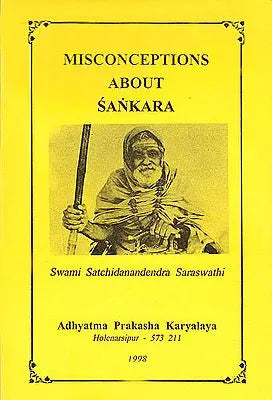
Misconceptions About Sankara (Shankaracharya)
Misconceptions About Sankara (Shankaracharya)
Paperback
Couldn't load pickup availability
DETAILS :
- Author : Swami Satchidanandendra Saraswathi
- Publisher : Adhyatma Prakasha Karyalaya, Holenarsipur
- Publication date : 1 January 1998
- Paperback : 125 pages
- Weight : 100 g
ABOUT THE BOOK
Misconceptions About Sankara (originally titled Sankara-hridaya-prakashika) is a surgical, scholarly critique by Swami Satchidanandendra Saraswathi. The book serves as a clarion call for a return to the pristine, original teachings of Adi Shankaracharya. Swamiji argues that over the centuries, Shankara’s "Kevala Advaita" (Pure Non-dualism) has been clouded by the interpretations of post-Shankara commentators, such as those of the Bhamati and Vivarana schools.
In this work, Swamiji systematically identifies and "corrects" what he considers to be fundamental deviations from Shankara’s actual philosophy. He addresses common misunderstandings regarding the nature of Avidya (ignorance), the role of the mind in liberation, and the true meaning of the "three states" (waking, dreaming, and deep sleep). Using rigorous logic and direct citations from Shankara’s Prasthanatrayi Bhashya (commentaries on the Upanishads, Bhagavad Gita, and Brahma Sutras), Swamiji demonstrates that later sub-commentaries often introduced dualistic or "quasi-dualistic" logic that Shankara himself had refuted. It is an essential, albeit challenging, read for serious students of Vedanta who wish to distinguish the "Master’s voice" from the "noise" of later scholastic traditions.
ABOUT THE AUTHOR
Swami Satchidanandendra Saraswathi (1880–1975) is revered as one of the greatest Advaitins of the 20th century. Born Y. Subba Rao, he dedicated his life to a singular mission: the "Return to Shankara." He believed that the direct method of the Upanishads had been lost to dry intellectualism and sought to revive the practical, experiential core of Vedanta. He founded the Adhyatma Prakasha Karyalaya in Holenarsipur, Karnataka, which remains a premier institution for the study of pure Advaita. His writing is known for its uncompromising adherence to logic and its deep, meditative clarity.
Share