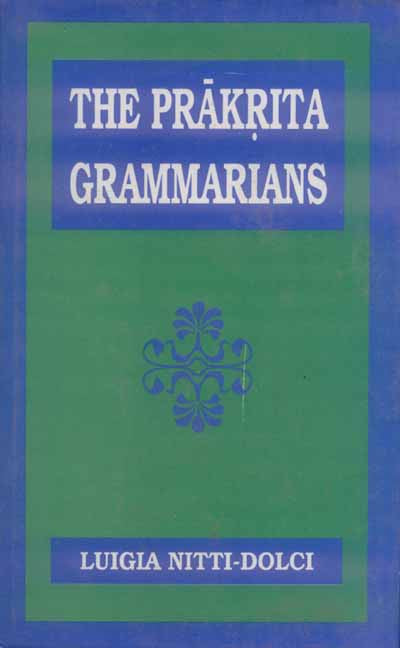
Prakrit Grammarians
Prakrit Grammarians
Couldn't load pickup availability
The present book is an English translation of Nitti Dolco's French work on the grammarians of the Prakrit languages.
Nitti Dolci's work, though written in the early nineteenth century, has remained the only uptodate treatise on the subject. Besides providing a chronological account of several well known authors - Bharata, Purusottama, Ramasarman, Markandeya, Kramadisvara, Hemachandra, Trivikarama, Canda and others - it offers a detailed study of the systems followed by them. Moreover, it presents an exegesis on a number of rules, of which interpretation had hitherto been difficult.
In addition to the textual criticism which forms the kernel, the book has a critical introduction, three appendixes, viz., list of abbreviations, index of names and index locarum. The translation is rendered in a lucid and intelligible style. The book will form a valuable companion to Pischel's Comparative Grammar of Prakrit language.
AUTHOR’S PREFACE
This book could not have come into being without the constant help and collaboration of my teacher, Mr. Jules B l o c h. I read with him elements of Sanskrit and principles of scientific research. In addition I believe to owe to him in a great measure my representation of historical facts and linguistic data about India. I can simply acknowledge this debt of which I do not have even the capacity to measure the extent.
Messrs Alfred F o u c h e r, Louis R e n o u, Helmer Smith of the University of Upsala and my friend Madame Stchoupak have helped me most ungrudgingly in my study of the subject and they have spared no pains in doing this. I alone am aware of amount of the facility that my researches have obtained from them.
Although Mr. Sylvain Levi had all through been very kind and cordial towards me, I could not dare often disturb him whose disciples had been my teachers. But chance has deprived me of the anxiously long-awaited happiness to carry the first printed copy of my book to him and to request him to go through it—alas the work of publication was interrupted by his death l The results of any serious research never left him indifferent; on so many occasions it so occurred to him that he would, even in books of mediocre merit, find an un- expected confirmation of a circumstance anticipated by him, and thus he would supply the last necessary link to complete the chain of facts coming closer together about the earth, so that the course of an idea could traverse in the world in the span of time and space.
In case he were still amongst us, I would have been less doubtful about the utility of my work and about the fruitfulness of these researches that at times appear so far remote from our daily occupations.
Introduction
11. In case any value can be attributed to the dates whatsoever, I should just rejoice at the fact that the present study has come to appear exactly one century after the publication of Institutiones Linguae Prakriticae of Christian Lassen. If I would have been born a century earlier, I think, I would have written to the author the words that Eugene Jacquet had addressed to him, “Your book is a masterpiece: not only all your observations are precious, but in Germany you alone still share with M. de Schlegel the credit of knowing method of handling the entire stock of materials with clarity and in a perfect order in writing a book.”
12. In these old pages, in these Latin sentences, that even today evoke certain amount of elegance, I began assiduously the study of Prakrit philology: in 1837 a rapid survey of available literature was made; till then scholars were not confronted with so large a mass of books and critical studies: in between these narrow limits one enjoys a bit of rest and he is able to cast his glance without fear from time to time on the Indian sub-continent.
13. When later I took up to the study of more complex and mature work of Richard Pischel, it was astonishing to discover that most of the opinions expressed in it had already been discussed, either in dissertations de grammaticis Pracriticis or in later works, going back to Lassen.
14. Lassen was the first scholar who, for example enunciated the rule by which later grammarians have described more dialects than the ancient ones. It was he who explained the superior status accorded to Maharastri on the basis of its stronger resemblance with Sanskrit. It was he who identified Paisaci with the dialects of North. West India etc.
15. These hypotheses have been partly refuted with the growth of our knowledge, but all of them find justification in the age when Lassen postulated them. Sometimes it would have been necessary to discard them rather, and I do not know the force of the inertia by which they often obstruct the passage of Pischel’s thought.
16. If we examine for example, the second paragraph of his Grammatik der Prakrit Sprachen and then compare it with the exposition of Lassen, we are obliged to recognise that still Lassen is most analytical and most precise.
17. But since it is Pischel alone who is being studied these days, we shall try, before we come to our subject proper, to clear away the ground of some preconceived ideas that are still found in Pischel.
18. When we refer to Dandin’s verse (Kavyadar’sa 1, 34) about Maharastri, we should not stop at the first half, because the second one offers the explanation:-
"Above all they consider the language spoken in the Maharastra country to be the best Prakrta (pracritica praecipuasays Lassen): ocean of beautiful expressions-these pearls! with which Setubandha and other poems have been composed.”
19. Dandin does not think of giving a linguistic classification: Maharastri is the best Prakrit, because it has the richest literature.
110. As for the explanation that Maharastri was considered to be the best Prakrit because it was probably closer to Sanskrit, it cannot be accepted without reservation, and none of the Indian grammarians has ever expressed such a heresay. Sauraseni, on the contrary, was for them, as for us, nearer to the source: cf. for example the formula of Markandeya. (Prakrtasarvasa, IX, 1).
Share