1
/
of
1
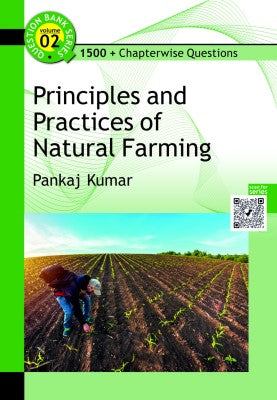
Principles and Practices of Natural Farming
Principles and Practices of Natural Farming
Regular price
$32.99 USD
Regular price
$54.98 USD
Sale price
$32.99 USD
Unit price
/
per
Couldn't load pickup availability
Author : Pankaj Kumar
Pages : 250
Year of Publication : 2026
Language : English
Binding : Paperback
Principles and Practices of Natural Farming is purpose-built to the ICAR course structure, mapping every chapter to the officially listed units and learning outcomes. It begins with India’s agricultural heritage and the modern history of natural farming, then develops core concepts—definitions, objectives, essential characteristics, and principles—before moving into the recognized pillars and schools of practice. The book integrates farm design and ecological balance; ecological engineering and community responsibility; ecological, water, carbon, and nitrogen footprints; ecosystem services; and integrated crop–tree–animal systems and cropping approaches. It further covers biodiversity and indigenous seed systems, farm-waste recycling, water conservation and renewable energy, animal rearing in natural systems, nutrient management, and pest–disease–weed management. Applied and enterprise topics include appropriate mechanization; processing, labelling, and economic viability; certification and standards; marketing and export potential; government and NGO initiatives for chemical-free agriculture; documented case studies; and entrepreneurship opportunities—ensuring students can connect on-farm practice with real-world value chains and policy support. To support assessment, each chapter concludes with 100 MCQs (single-best, numerical, assertion–reason, matching), yielding practice questions aligned unit-wise to the ICAR syllabus—complete with an answer key for self-evaluation. Overall, the text blends concept, method, and application so learners can move confidently from classroom and lab to field and enterprise—exactly as envisioned in the ICAR curriculum for Natural Farming.
Pages : 250
Year of Publication : 2026
Language : English
Binding : Paperback
Principles and Practices of Natural Farming is purpose-built to the ICAR course structure, mapping every chapter to the officially listed units and learning outcomes. It begins with India’s agricultural heritage and the modern history of natural farming, then develops core concepts—definitions, objectives, essential characteristics, and principles—before moving into the recognized pillars and schools of practice. The book integrates farm design and ecological balance; ecological engineering and community responsibility; ecological, water, carbon, and nitrogen footprints; ecosystem services; and integrated crop–tree–animal systems and cropping approaches. It further covers biodiversity and indigenous seed systems, farm-waste recycling, water conservation and renewable energy, animal rearing in natural systems, nutrient management, and pest–disease–weed management. Applied and enterprise topics include appropriate mechanization; processing, labelling, and economic viability; certification and standards; marketing and export potential; government and NGO initiatives for chemical-free agriculture; documented case studies; and entrepreneurship opportunities—ensuring students can connect on-farm practice with real-world value chains and policy support. To support assessment, each chapter concludes with 100 MCQs (single-best, numerical, assertion–reason, matching), yielding practice questions aligned unit-wise to the ICAR syllabus—complete with an answer key for self-evaluation. Overall, the text blends concept, method, and application so learners can move confidently from classroom and lab to field and enterprise—exactly as envisioned in the ICAR curriculum for Natural Farming.
Share