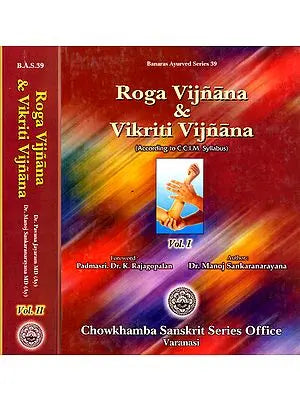
Roga Vijnana and Vikriti Vijnana: According to C.C.I.M Syllabus (Set of 2 Volumes)
Roga Vijnana and Vikriti Vijnana: According to C.C.I.M Syllabus (Set of 2 Volumes)
Hardcover
Couldn't load pickup availability
DETAILS :
- Author : Dr. Manoj Sankaranarayana
- Publisher : Chowkhamba Sanskrit Series Office
- Publication date : April 1, 2014
- Edition : 2014th
- Binding : Hardcover
- Language : English
- ISBN-10 : 8170804388
- ISBN-13 : 978-8170804383
- Weight : 2500 g
ABOUT THE BOOK SET
Roga Vijnana and Vikriti Vijnana by Dr. Manoj Sankaranarayana is a foundational two-volume textbook specifically authored to meet the rigorous requirements of the Central Council of Indian Medicine (CCIM) syllabus. It serves as the bridge between ancient Ayurvedic wisdom and modern diagnostic pathology for BAMS (Bachelor of Ayurvedic Medicine and Surgery) students.
- Volume 1 focuses on the principles of Vikriti Vijnana (Pathology), explaining the imbalances of the Doshas, Dhatus, and Malas. It covers the concept of Samprapti (Pathogenesis) and how diseases manifest from a cellular to a systemic level.
- Volume 2 delves into Roga Vijnana (Clinical Diagnosis), detailing specific diseases, their classifications, and diagnostic methods.
The unique strength of this set is its "Integrated Approach." Dr. Sankaranarayana explains Ayurvedic concepts alongside modern medical pathological findings, ensuring that students can interpret ancient texts like the Charaka Samhita and Sushruta Samhita in a contemporary clinical context. It is widely considered an essential "survival guide" for clearing university exams while building a strong diagnostic foundation for future practitioners.
ABOUT THE AUTHOR
Dr. Manoj Sankaranarayana is a highly respected academician and clinician in the field of Ayurveda. He is known for his ability to simplify the complex Sanskrit terminologies of the classical texts into clear, logical explanations. His work is deeply influenced by his years of teaching experience, which is evident in the book's structured layout, use of flowcharts, and emphasis on high-yield topics. He remains a dedicated advocate for evidence-based Ayurveda, helping the next generation of doctors combine traditional pulse-reading and observation with modern laboratory investigations.
Share