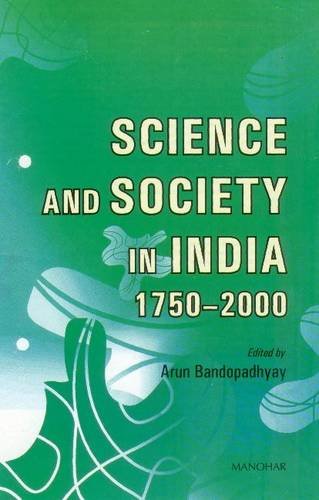
Science and Society in India c. 1750-2000
Science and Society in India c. 1750-2000
Hardcover
Couldn't load pickup availability
DETAILS :
- Author: Arun Bandopadhyay
- Publisher: Manohar Publishers and Distributors
- Publication date: 7 November 2012
- Language: English
- Print length: 390 pages
- ISBN-10: 8173048541
- ISBN-13: 978-8173048548
- Item Weight: 700 g
ABOUT THE BOOK
Science and Society in India c. 1750–2000, edited and compiled by the distinguished historian Dr. Arun Bandopadhyay, is a monumental, pioneering anthology that explores the social history of science, technology, and medicine (HSTM) in modern India. Published by Manohar Publishers & Distributors in association with the Project of History of Indian Science, Philosophy and Culture (PHISPC), this comprehensive volume is an absolute cornerstone for academic researchers. The core philosophy of this text centers on deconstructing the colonialist claim that modern science was a purely Western gift to a passive Indian subcontinent. Instead, Bandopadhyay presents a nuanced framework illustrating how scientific ideas were actively negotiated, resisted, adapted, and institutionalized by Indian society across two and a half centuries of deep socio-political transformation.
The volume is structurally organized into chronological and thematic sections that transition seamlessly from the twilight of the Mughal Empire to the dawn of the 21st century. It begins by examining the state of indigenous sciences and traditional knowledge systems around 1750, followed by a sharp critique of the "Colonial Tool" era, where sciences like cartography, botany, geology, and medicine were weaponized by the East India Company to map, classify, and exploit Indian resources. The middle sections focus heavily on the Indian Renaissance of the late 19th and early 20th centuries, documenting the stellar rise of nationalistic scientific institutions spearheaded by icons like Mahendralal Sircar, J.C. Bose, and P.C. Ray, who fought for scientific autonomy. The final modules critically evaluate post-Independence India’s big-science paradigms—including the Nehruvian scientific temper, the Green Revolution, atomic energy programs, and the complex, modern-day tensions between globalized technology and grassroots environmental movements.
ABOUT THE AUTHOR
Dr. Arun Bandopadhyay is an elite Indian historian and former Nurul Hasan Professor of History at the University of Calcutta. Celebrated as an authoritative voice in agrarian history, environmental economics, and the history of science in South Asia, his rigorous archival research has shaped modern historiography. He has served on numerous national historical commissions and editorial boards dedicated to preserving India’s rich intellectual and scientific heritage.
Bandopadhyay’s editorial and analytical style is exceptionally rigorous, objective, and deeply rooted in extensive archival documentation. Writing with the analytical precision of a veteran social scientist, he avoids simplistic nationalistic romanticism and dense, uncritical post-modern jargon. Instead, he maintains a balanced, peer-to-peer scholarly narrative that connects laboratory breakthroughs directly to the socio-economic realities of the wider public. By balancing micro-historical case studies with broad civilizational shifts, his collective literature remains an indispensable reference standard for university history departments, civil services aspirants focusing on history and sociology, and international scholars tracking the global evolution of scientific knowledge.
Share