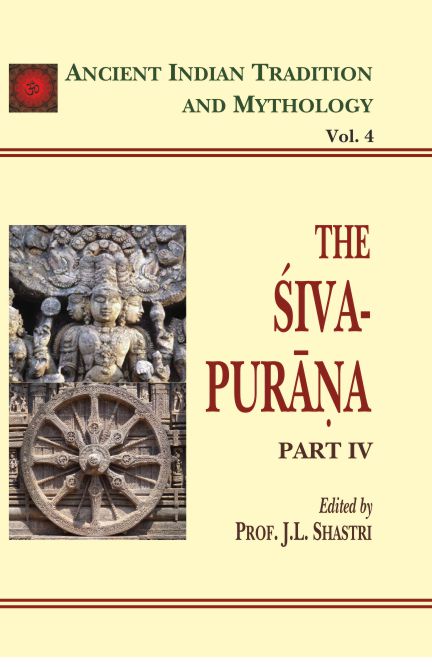
Siva Purana English Translation -4 Volumes
Siva Purana English Translation -4 Volumes
Hardcover
Couldn't load pickup availability
📖 Product Details
- Author: by J. L. Shastri
- Publisher: Motilal Banarsidass Publishers
- Publication date: January 1, 2014
- Edition: First Edition
- Language: English, English
- Print length: 2174 pages
- ISBN-10: 8120838181
- ISBN-13: 978-8120838185
- Item Weight: 3000 G
📘 About the Book
The Purana is a class of literature that treats ancient religion, philosophy, history, sociology, politics, and other subjects. It is an Encyclopaedia of various branches of knowledge and ancient wisdom. It has been defined as a class of literature that contains material on the topics of Creation, Dissolution of Manus, Ages of Manus, Genealogies, and the History of glorious kings. For dealing primarily with these subjects it has been called Pancalaksana a little that was incorporated in the Puranas themselves and had become popular by the Fifth Century A.D., for it was included by Amarasimha in his lexicon 'Amarakosa'. But as the process of interpolation continued, the Pancalaksana definition was found inadequate. The Puranic redactors adopted a Dasalaksana definition that suited the contemporary text. Still, the dynamic forces were at work and the process of insertion, modification, and abridgment went on it was soon discovered that the Dasalaksana definition too fell short of an actual fact. It was found that the Puranas contained certain aspects that were not covered by any of the five or ten characteristics. Besides some of the characteristics covered by the Pancalaksana or Dasalaksana definition were not found in certain Puranas. In fact, the Purana as a class represents the different phases and aspects of the life of diverse ages. It is impossible to adopt a standard definition for the class of literary composition that contains heterogeneous phases and aspects. Moreover, a definition framed on the numerical basis of points is bound to be imperfect.
The Puranas are divided into two classes the Mahapuranas and the Upapuranas. Each class consists of eighteen Puranas. Thus the number of Puranas is thirty-six. The Mahapuranas are classified into different categories Vaisnava, Brahma, Saiva, etc. in proportion as they accord preferential treatment to Visnu, Brahma, Siva, and others. Sivapurana, as its title signifies is a Saiva Purana. It derives its designation from the fact that it eulogizes the glory and greatness of Siva, describes the ritual and philosophical principles of the Siva cult, embodies descriptions, sermons, and dissertations on the greatness of his divinity, recounts his emblems, attributes, exploits, and incarnations, narrates legends on the origin and importance of his phallic image and dwells upon the merit of installing and consecrating that image. In brief, Siva-Purana is a sacred treatise of Siva's legends and rituals.
The extant text of Sivapurana is arranged into seven Samhitas designated as Vidyesvara, Rudra, Satarudra, Kotirudra, Uma, Kailasa, and Vayaviya. The second of these, Rudrasamhita, is divided into five sections, viz. Creation, the narrative of Sati, the biography of Parvati, the birth and adventures of Kumara and Siva's battles. The seventh Samhita-Vayaviya- has two parts (Purvabhaga and Uttarabhaga). It is called Vayaviya, for though it was recited by the Suta at the Naimisa Forest, it was originally proclaimed by Vayu at the advent of Svetakalpa.
According to the records of the Vayaviya, the original Sivapurana consisted of twelve Samhitas. That is to say, in addition to the extant seven, there were five more Samhitas viz. Vainayaka, Matr, Rudraikadasa, Sahasrakoti and Dharma. The complete group of twelve Samhitas comprised one hundred thousand Slokas. But five of the group were dropped in the course of reconstruction and abridgment of the Puranas. The extant Sivapurana is an abridged edition and comprises twenty-four thousand Slokas. The redaction was made by the sage Krsna Dvaipayana Vyasa himself.
As previously stated, the Mahapuranas are eighteen in number. The Puranic scholars agreed upon the authenticity of the seventeen Mahapuranas but in regard to the eighteenth, there is a difference of opinion. Most of the Puranas include Sivapurana in the list while a few others substitute Vayu for Siva. The substitution of either was inevitable, for the traditional number had to be maintained. Therefore some voted in favor of Siva, and some in favor of Vayu. Neither of the parties could agree on which of the two was actually a Mahapurana.
Now let us examine if any solution could at all be possible. We know that Sivapurana is divided into seven Samhitas, one of which is the Vayaviya. We have the testimony of Sivapurana itself that the original Sivapurana consisting of one hundred thousand slokas was abridged into twenty-four thousand slokas. On the strength of this evidence, it cannot be unreasonable to suppose that there was a proto-Sivapurana and a proto-Vayaviya. It is not unlikely that there was a close affinity between the extant Vayupurana and the proto-Vayaviya or that the extant Vayupurana is a recension of the proto-Vayaviya and thus a part of Sivapurana itself. The solution lies in assuming the identicality of the two on the basis of this suggestion, not in accepting the one and rejecting the other.
Sivapurana has all the characteristics of a Mahapurana. According to the ancients, a Mahapurana contained five main characteristics that concerned either early religion or traditional history. Of these, the origin of the universe (Sarga) is an important feature of every religion. As a Mahapurana and a sacred work of the Siva cult, Sivapurana possesses this important trait. It discusses the origin of the universe which it traces to Siva, the eternal god who though devoid of attributes still has an inherent Energy that manifests itself in the form of three principles Sattva, Rajas, and Tamas personified as the three deities Visnu, Brahma, and Rudra. The three have their respective energies called Laksmi, Sarasvati, and Kali, in collaboration with whom they create, maintain, and dissolve the universes.
According to this account, the work of creation is entrusted to Brahma who creates the cosmic egg is insentient at first but when Visnu pervades it, it goes in motion. Then different kinds of creation are evolved out of it.
Share