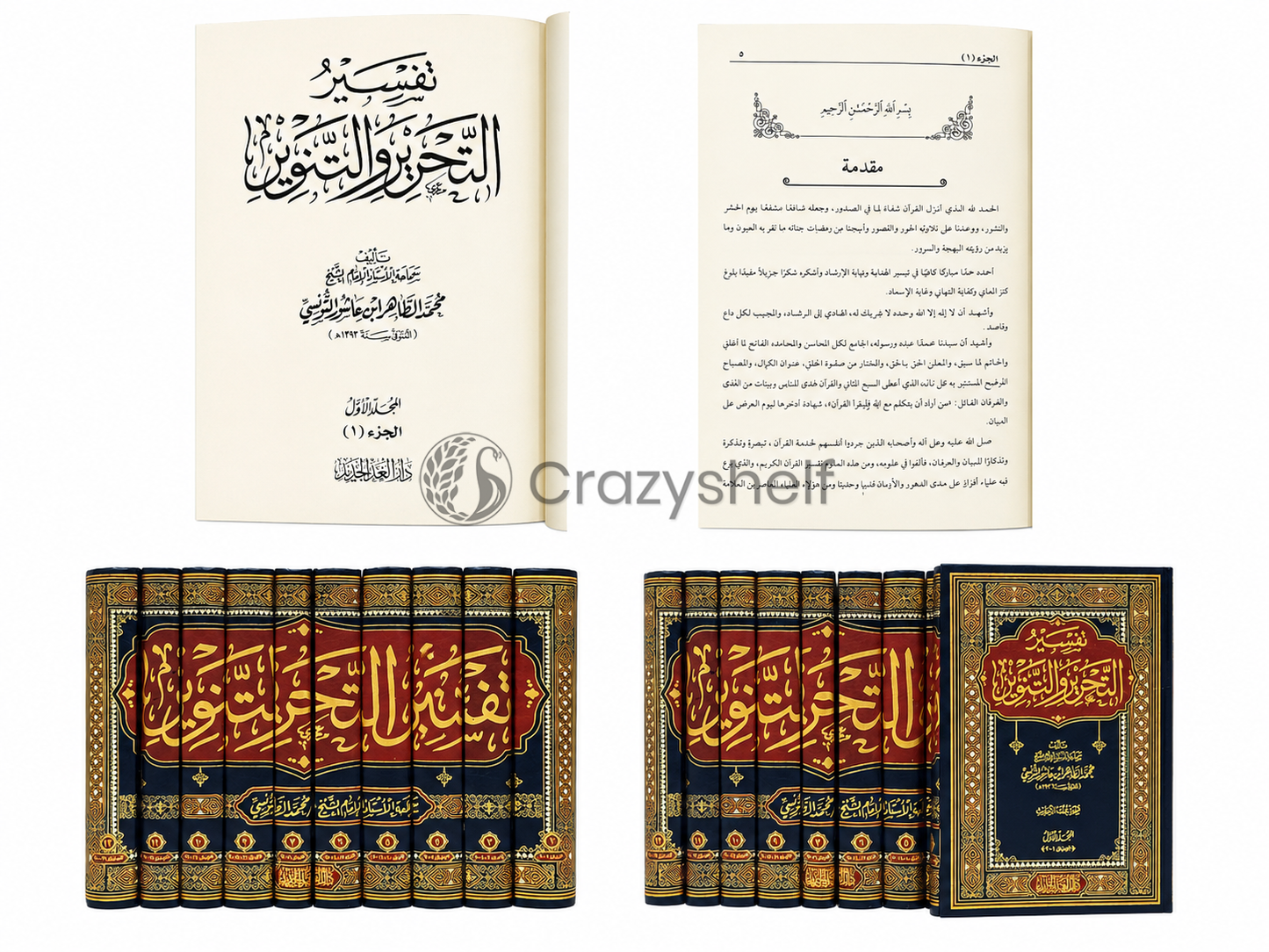
"Tafsir al-Tahrir wa'l-Tanwir" (12 Volumes)
"Tafsir al-Tahrir wa'l-Tanwir" (12 Volumes)
Hardcover
Couldn't load pickup availability
DETAILS :
- Author : Shaykh Muhammad al-Tahir ibn Ashur
- Publisher : Dar Ibn Hazm
- Binding : Hardcover
ABOUT THE SET
Tafsir al-Tahrir wa'l-Tanwir (تفسير التحرير والتنوير)—fully titled تحرير المعنى السديد وتنوير العقل الجديد من تفسير الكتاب المجيد (The Verification of the Sound Meaning and Enlightenment of the New Mind from the Exegesis of the Glorious Book)—is widely celebrated as the pinnacle of 20th-century North African Islamic scholarship. Composed by the legendary Tunisian polymath and Grand Mufti Shaykh Muhammad al-Tahir ibn Ashur (1879–1973), this monumental Qur'anic commentary represents the culmination of over fifty years of continuous, exhaustive research.
The core philosophy of this text centers on intellectual renewal (Tajdid) and structural precision without severing traditional anchors. Rather than merely repackaging classical medieval commentaries, Ibn Ashur treats the Qur'an as a dynamic, living text. He positions himself at the critical intersection of classical Arabic rhetoric (Balaghah) and a highly modern, reformist legal framework that aims to demonstrate how the immutable text answers contemporary social, ethical, and legal questions.
ABOUT THE AUTHOR
Shaykh Muhammad al-Tahir ibn Ashur was a giant of Islamic jurisprudence, a descendant of an elite scholarly family of Andalusian origin, and the Shaykh al-Islam (Grand Mufti) of the Maliki school in Tunis. For much of his career, he served as the distinguished rector of the prestigious Ez-Zitouna University—one of the oldest educational institutions in the Muslim world.
Living through the volatile shift from French colonial rule to Tunisian national independence, Ibn Ashur actively fought against two extremes: rigid, unthinking imitation of old texts (Taqlid) and radical secularization that sought to detach North African culture from its Islamic roots. Influenced heavily by the reformist ideals of Muhammad Abduh, he revitalized the study of Maqasid al-Shariah (the higher objectives of Islamic Law). His legal and linguistic scholarship was so precise that he is universally revered today as one of the modern eras most authoritative voices in Quranic linguistic science and legal philosophy.
Share