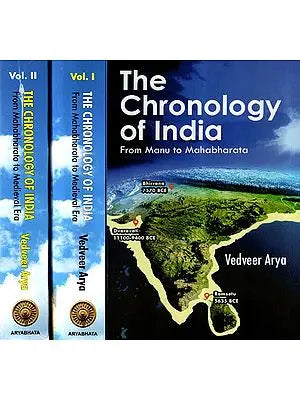
The Chronology of India- From Manu to Mahabharata (Set of 3 Books in 2 Volumes)
The Chronology of India- From Manu to Mahabharata (Set of 3 Books in 2 Volumes)
Paperback
Couldn't load pickup availability
DETAILS :
- Author : Vedveer Arya
- Publisher : Aryabhata Publications
- Edition : Special Edition
- Language : English
- Paperback : 2100 pages
- Weight : 2900 g
ABOUT THE BOOK
"The Chronology of India- From Manu to Mahabharata" is a 3-volume book set by Vedveer Arya that explores India's ancient history, focusing on the period from Manu to the Mahabharata era. This comprehensive work provides insights into the country's rich cultural heritage and historical timeline. The book is ideal for scholars, researchers and history enthusiasts seeking to understand India's ancient past. With meticulous research and analysis, Arya sheds light on the chronology of significant events and figures in Indian history.
ABOUT THE AUTHOR
Vedveer Arya, an officer of the Indian Defence Accounts Service is a postgraduate in Sanskrit from Delhi University. He is presently Finance Manager (Maritime & Systems), Ministry of Defence, New Delhi. His deep interest in the ancient heritage and history of India propelled him to become a researcher with profound insights in the chronological history of India. He made an in-depth study of various ancient Indian epigraphs in original and critiqued the chronology of India put forth by colonial historians and their followers. He has also worked on the scientific contributions of ancient India.
He is the author of Indian Contributions to Mathematics and Astronomy (2014), The Chronology of Ancient India: Victim of Concoctions and Distortions (2015), The Chronology of India: From Manu to Mahabharata (2019), The Chronology of India: From Mahabharata War to Medieval Era, in two volumes (2019), The Origin of the christian Era: Fact or Fiction (2019).
INTRODUCTION
Ancient Indian history begins with Brahma, the founder of Vedic sciences, and his son Svayambhuva Manu, the first king of the Brahmavarta kingdom. A few kings and kingdoms may have existed before the lifetime of Brahma but the official recordkeeping of the genealogy of Indian kings and their history commenced from Brahma and his son Manu. Traditionally, the Sutas and the Magadhas were entrusted with the task of maintaining this multigenerational chronological genealogy of the Manu and the Puru dynasties, charting their lineages since the early Rigvedic period. Though the two communities pursued their ancestral duty with utmost dedication, it was never a feasible expectation to maintain this continuity for thousands of years, which is perhaps why there are some gaps in the chronological genealogy of various dynasties. These historical records had been formally compiled into Purana-Itihasa Samhitas for the first time by Veda Vyasa's pupil Romaharsana Suta, during the later Rigvedic period. After this, the subject of Purana-Itihasa formally became a part of Vedic education and the pupils of Romaharsaha Suta also compiled Puraha Samhitas. The tradition of periodic compilation of Bhavisyat Purana was introduced in the post-Vedic period. Then, the same Puraha Samhitas were recompiled in Laukika Sanskrit later, and came to be known as Puranas.
It seems that the tradition of historical recordkeeping declined after the reign of the Iksvaku King Agnivarna, the 25th descendant of Sri Rama. Kalidasa abruptly ended his Raghuvamsa Mahakavya after the reign of Agnivarna, probably due to a long interregnum in genealogical continuity of the Raghu dynasty. Evidently, the Iksvaku dynasty had declined after the reign of Agnivarna. Vyasa, of the Mahabharata era, revived the tradition of the study of Puranas and recompiled them into eighteen Puranas. Some Upapuranas were also compiled after the Mahabharata era. The Puranas available to us, it seems, were finally recompiled and updated around 500-100 BCE. This revived Puranic tradition survived till the Gupta period. Only Bhavisyat Purana continued to be periodically updated after the Gupta period.
Puranas narrate the continuous genealogical and chronological history of ancient India, starting from the Mahabharata war, and the coronation of King Yudhisthira, and ending at the Gupta period. All Indian traditional and literary sources unanimously indicate the date of the Mahabharata war to be in the 32nd century BCE and epigraphic evidence of the Aihole inscription' conclusively establishes the date of the Mahabharata war in 3162 BCE.
Puranas refer to the Saptarsi calendar that commenced around 6777 BCE, assuming the hypothetical position of Saptarsis (the Big Dipper) in Asvini Naksatra. Accordingly, Puranas, Vrddhagarga and Varahamihira, and other ancient scriptures unambiguously mention that the Saptarsis were in Magha Naksatra around 3177-3077 BCE, during the reign of King Yudhisthira. A reconstructed land grant of King Janamejaya, son of Pariksit, was found in Tirthahalli district of Karnataka, which is dated in the 89th year of the Yudhisthira era (3073-3072 BCE).2 So, Puranas relate the complete genealogies of various dynasties of Magadha Empire after the Mahabharata war. We also have sufficient epigraphic evidence starting from the reign of King Asoka. Thus, we can factually and accurately establish the chronological history of ancient India from the Mahabharata war (3162 BCE) to modern times, and we will discuss this in detail in the second volume of this book.
The tougher challenge is to establish the chronology of ancient India beyond the date of the Mahabharata war. Traditionally, Puranas follow the timeline of Chaturyuga cycle for narrating the chronological history of ancient India - however, the timeline of Chaturyuga cycle had been revised and enlarged during the post-Vedic and the post-Ramayana eras with an objective to achieve accurate astronomical calculations in whole numbers, because ancient Indian astronomers preferred to work with whole numbers instead of odd fractions. Unfortunately, the original Purana Samhitas written by Romaharsana Suta and his pupils, the earliest versions of Puranas, have been lost long ago. In fact, it seems even the Ramayana and the Mahabharata have been recompiled during the Satavahana-Gupta period.
The available versions of Puranas, and the Ramayana and Mahabharata relate numerous legends of the Vedic and post-Vedic period and also provide the genealogical information of various dynasties and lineages starting from the time of Vaivasvata Manu. Since the later timeline of Manvantaras and Chaturyugas consisted of the cycles of millions of years, it has been assumed that the great rishis and kings will be reborn in the beginning of Vaivasvata Manvantara. This may be the reason why the updaters of Puranas give almost all genealogies starting from the time of Vaivasvata Manu though they have propounded the beginning of the chronological history of ancient India from Svayambhuva Manu. This contradictory assumption led to some chronological inconsistencies in the narratives of various genealogies as well as certain misplaced identifications of historical personalities with identical names. One of the biggest mistakes committed by the Puranic updaters is the misidentification of Veda Vyasa of Rigvedic era as Vyasa of the Mahabharata era that led to the concocted concept of twenty eight Vyasas and the impossible theory of eight chirajivins. The later timeline of millions of years also misled the Puranic updaters to assign 60000 years to King Sagara and 11000 years to King Rama and suchlike. The popularity of Adbhuta Rasa in Sanskrit poetry and drama, and the poetic exaggeration of narratives, had gradually transformed the historical legends into historico-mythological legends.
Share