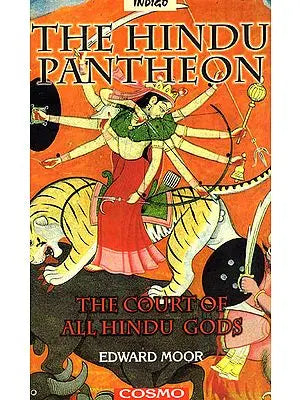
The Hindu Pantheon: The Court of all Hindu Gods
The Hindu Pantheon: The Court of all Hindu Gods
Couldn't load pickup availability
DETAILS:
- Author : by Edward Moor and William Simpson
- Publisher : Cosmo Publications
- Publication date : 15 February 2003
- Edition : New edition
- Language : English
- Print length : 412 pages
- ISBN-10 : 8129200007
- ISBN-13 : 978-8129200006
- Item Weight : 750 g
ABOUT THE BOOK
The Hindu Pantheon: The Court of All Hindu Gods, originally published in 1810 by the British military officer and scholar Edward Moor, is one of the most significant—and historically contested—early Western attempts to document, categorize, and illustrate the vast complexities of Hindu iconography, mythology, and theology. This monumental work served for decades as the foundational text through which European scholars and colonial administrators perceived the deities of the Indian subcontinent. The core philosophy of this text centers on iconographic codification—attempting to bring systematic Western taxonomic order to the fluid, multi-dimensional, and often symbolic nature of Hindu religious imagery.
The book is structured as an expansive descriptive catalog, moving systematically through the major deities of the Hindu trinity (Trimurti)—Brahma, Vishnu, and Shiva—and their various incarnations (Avatars), consort deities, and associated mythological figures. It is particularly renowned for its detailed plates, many of which were illustrated by the artist William Simpson in subsequent editions or influenced the visual interpretative style of the time. The text provides a rigorous analysis of the attributes, vehicles (Vahanas), and symbolic weapons associated with each deity, attempting to correlate these with historical, astronomical, and allegorical interpretations derived from early translations of Sanskrit texts.
ABOUT THE AUTHOR
Edward Moor (1771–1848) was an officer in the Bombay Army of the East India Company. His work was born out of deep personal interest in the antiquities he encountered while stationed in Western India. Though modern scholarship recognizes the inherent colonial limitations and occasional misinterpretations in his work, it remains an essential primary document for understanding the history of Indology and how religious knowledge was formally archived during the colonial encounter.
Share