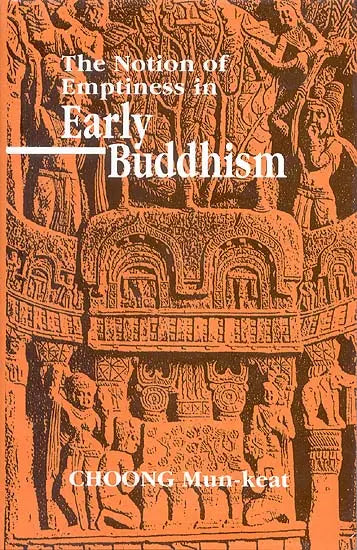
The Notion Of Emptiness In Early Buddhism
The Notion Of Emptiness In Early Buddhism
Couldn't load pickup availability
Details :
Author : Choong Mun-Keat
Publisher : Motilal Banarsidass Publishers
Prublication Date : 1 January 1999
Language : English
Hardcover : 145 pages
ISBN-10 : 8120816498
ISBN-13 : 9788120816497
Item Weight : 350 g
About the book
This book investingates the teachings of emptiness in early Buddhism, as recorded in the Pali and Chinese version of the early Buddhist canon. In general, the finding is that these two version, although differently worded, recorded in common that the teaching of the historical Buddha as connected with emptiness. The general reader, with little or no prior knowledge of Buddhism, can discover in this book how early Buddhism provides a vision and a method to help in overcoming the ills of the mind.The notion of emptiness is mainly applied in the teachings of "empty of self-attachment" and "empty of the two extremes." By way of the wisdom of right view, leading to the highest peaceful state (nirvana), the mind can, in this very life, be fully liberated from (empty of) suffering, affliction, and distress. Having shown that the emptiness-teachings are common to the Pali and Chinese versions, the author concludes that the notion of emptiness had arisen already in the period of the early Buddhist sutras, and was not simply a creation of the Mahayana.
About the Author
CHOONG MUN-KEAT (Wei-keat) studied Chinese and Pali Buddhism in Malaysia, Taiwan and Sri Lanka, before obtaining his Bachelor of Arts (1990) in the Faculty of Buddhist Studies at Komazawa University (Tokyo), and his Master of Arts in Studies in Religion (1994) and Ph.D. (1998) in the area of Buddhist Studies in the Department of Studies in Religion at the University of Queensland. His Ph.D. thesis topic is: The Fundamental Teachings of Early Buddhism: A Comparative Study Based on the Sutra-anga Portion of the Pali Samyutta-nikaya and the Chinese Samyuktagama. His research interests lie in comparative studies of the Pali and Chinese versions of the early Buddhist canon.
Share