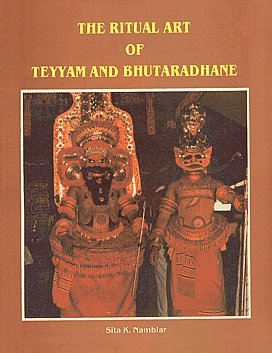
The Ritual Art of Teyyan and Butaradhane
The Ritual Art of Teyyan and Butaradhane
Hardcover
Couldn't load pickup availability
DETAILS :
- Author : Sita K. Nambar
- Publisher : Motilal Banarsidass Publications
- Publication date : 1 October 2002
- Language : English
- Hardcover : 144 pages
- ISBN-10 : 8170131499
- ISBN-13 : 978-8170131496
- Item Weight : 1 kg
ABOUT THE BOOK
The Ritual Art of Teyyam and Bhutaradhane is a scholarly and visually rich exploration of two of South India's most powerful "ritual theatres." Published under the aegis of the Indira Gandhi National Centre for the Arts (IGNCA), the book bridges the gap between folklore and metaphysical philosophy.
The text focuses on:
- Spirit Mediumship: It provides a deep dive into how performers in North Kerala (Teyyam) and South Karnataka (Bhutaradhane) undergo a total transformation—transcending their human identity to become vessels for deities, ancestral spirits, and heroes.
- Artistic Synthesis: The book documents the multi-media nature of these rituals, covering the creation of massive, intricate headgears (Mudi), the symbolic use of facial colors (natural pigments like turmeric and charcoal), and the specific rhythms of the drums.
- Socio-Cultural Context: It examines how these performances allow marginalized communities to assume roles of divine authority, often using the ritual space to comment on or resolve social inequities and village grievances.
- Textual Links: As a Sanskrit scholar, the author uniquely relates these "Little Traditions" to the "Great Tradition" of Indian Sastras, finding parallels between folk practices and classical Indian aesthetics.
ABOUT THE AUTHOR
Dr. Sita K. Nambiar was a distinguished scholar of Sanskrit and Indian philosophy. She held a deep interest in the intersection of classical texts and living folk traditions. Beyond this work, she is well known for her translation and commentary on the Prabodhacandrodaya (an allegorical Sanskrit play) and her work on the Svanubhuti of Appayya Dikshita.
Dr. Nambiar was recognized for her ability to decode the complex symbology of Indian rituals without stripping them of their spiritual soul. Her collaboration with the IGNCA and other cultural institutions helped bring academic legitimacy and preservation to the "fragile" oral and ritualistic traditions of the Malabar and Tulunadu regions.
Share