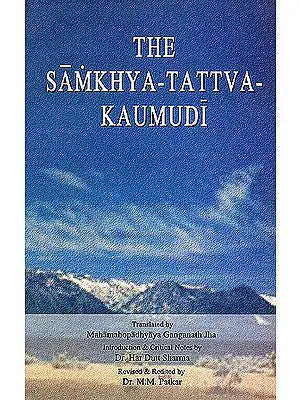
The Samkhya-Tattva-Kaumudi
The Samkhya-Tattva-Kaumudi
Paperbaclk
Couldn't load pickup availability
DETAILS :
- Author : Mahamahopadhyaya Ganganath Jha
- Publisher : Chaukhamba Sanskrit Pratishthan
- Language : Sanskrit
- Paperback : 355 pages
- Weight : 300 g
ABOUT THE BOOK
The Samkhya-Tattva-Kaumudi is a seminal text in Indian philosophy, featuring the authoritative translation and commentary by the legendary scholar Mahamahopadhyaya Ganganath Jha. This work is a detailed exposition of Vacaspati Misra’s Tattva Kaumudi, which itself is a celebrated commentary on Ishvara Krishna’s Samkhya Karika—the foundational text of the Samkhya school.
Samkhya is one of the oldest "Astika" (orthodox) schools of Indian philosophy, characterized by its dualistic approach to reality. The book meticulously breaks down the interaction between:
- Purusha: The pure, eternal consciousness.
- Prakriti: The primordial matter or creative energy.
Ganganath Jha’s translation is prized for its precision and its ability to navigate the complex "tri-guna" theory (Sattva, Rajas, and Tamas) and the 24 tattvas (elements) of cosmic evolution. This edition is indispensable for students of metaphysics, as it provides a logical, non-theistic framework for understanding the liberation of the self from the bonds of material existence.
ABOUT THE AUTHOR
Mahamahopadhyaya Sir Ganganath Jha (1872–1941) was a colossus of Sanskrit scholarship and a pioneer in the modern academic study of Indian philosophy. He served as the Vice-Chancellor of the University of Allahabad and was the first scholar to receive the hereditary title of "Mahamahopadhyaya" (Greatest among great teachers) from the British government for his services to Oriental learning.
Dr. Jha was a polyglot and a prolific translator, credited with bringing some of the most obscure and difficult Sanskrit texts—including the Manusmriti, the Shabara Bhashya, and various Nyaya texts—into the English language. His work is characterized by a "Pandit-like" depth of traditional knowledge combined with a rigorous modern critical method. He didn't just translate words; he translated the very essence of ancient Indian thought, ensuring that the intellectual heritage of the East remained accessible to the global academic community.
Share