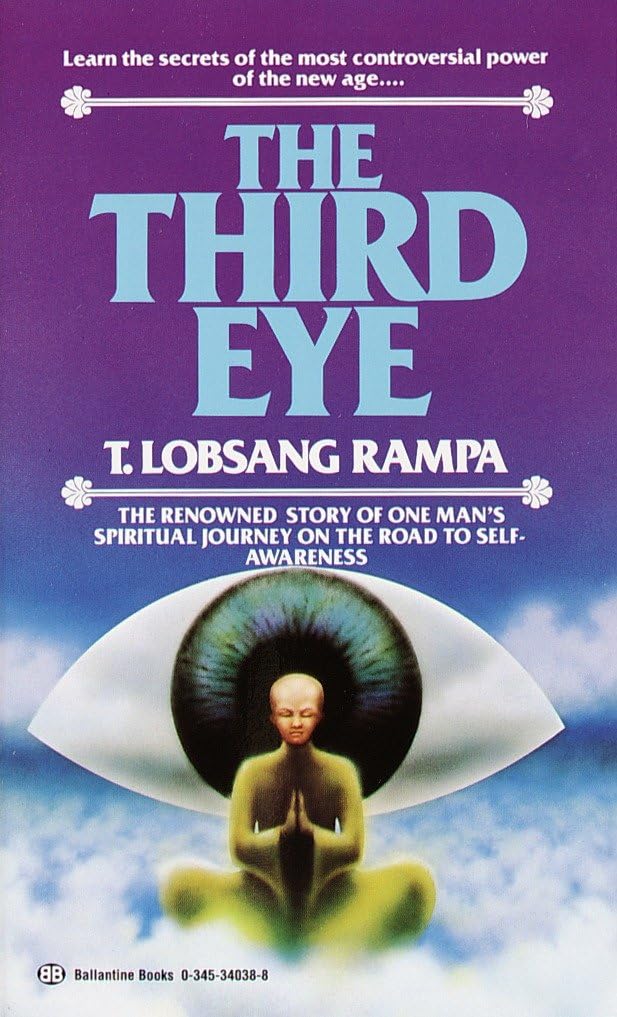
Third Eye by T. Lobsang Rampa
Third Eye by T. Lobsang Rampa
Paperback
Couldn't load pickup availability
DETAILS :
- Author : T. Lobsang Rampa
- Publisher : Ballantine Books
- Publication date : 12 June 1986
- Edition : 2nd
- Language : English
- Paperback : 224 pages
- ISBN-10 : 0345340388
- ISBN-13 : 978-0345340382
- Item Weight : 200 g
ABOUT THE BOOK
The Third Eye is one of the most famous and controversial works in the genre of spiritual autobiography, purported to be the true life story of a high-ranking Tibetan lama. First published in 1956, the book describes the childhood of T. Lobsang Rampa in Lhasa, his rigorous training at the Chakpori Lamasery, and his eventual "operation" to open the third eye. This procedure, described in vivid detail, involved a physical piercing of the forehead to awaken heightened psychic abilities, including the capacity to see auras and perceive the true nature of individuals. The narrative is filled with atmospheric descriptions of Himalayan life, Tibetan herbal medicine, and esoteric Buddhist practices, capturing the imagination of a Western audience eager for glimpses into the "Forbidden Land."
The book became an international bestseller, serving as an early gateway for many Westerners into the world of Tibetan Buddhism and occultism. However, its legacy is deeply tied to a sensational literary scandal. Shortly after its release, researchers and practitioners of Tibetan culture began to question the book's authenticity. It was eventually revealed that the author was not a Tibetan lama but an English plumber’s son named Cyril Henry Hoskin, who had never visited Tibet. Despite this exposure, the book remains in print and continues to be read as a work of "spiritual fiction" or "channeled" wisdom, with many readers arguing that the insights into human auras and metaphysical truths hold value regardless of the author's physical origins.
ABOUT THE AUTHOR
T. Lobsang Rampa (born Cyril Henry Hoskin, 1910–1981) was a British-born author who claimed that his body had been taken over by the spirit of a Tibetan monk. Even after being outed by a private investigator, he maintained his identity as Rampa, stating that he had undergone a "transmigration" of souls to fulfill his mission of spreading Tibetan wisdom. Over his career, he wrote nearly twenty books on subjects ranging from astral travel and telepathy to the nature of the afterlife. While widely dismissed by scholars and the Tibetan government-in-exile, Rampa’s works played a massive role in the mid-century "New Age" movement, influencing a generation’s perception of Eastern mysticism.
Share