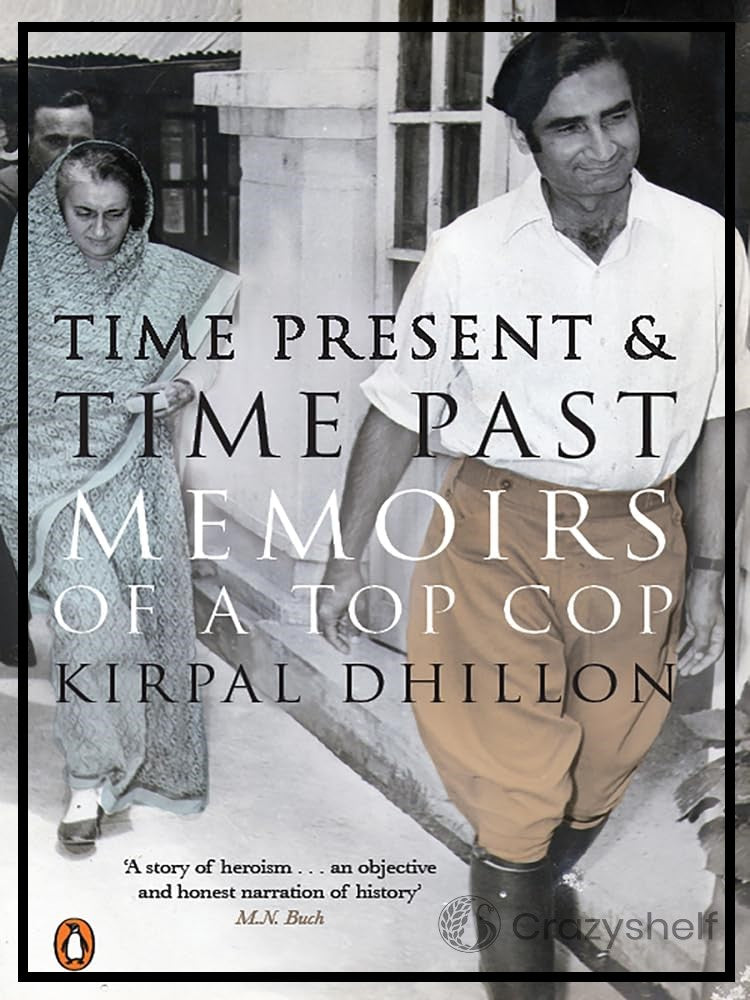
Time Present & Time Past (Memoirs of a Top Cop)
Time Present & Time Past (Memoirs of a Top Cop)
Paperback
Couldn't load pickup availability
DETAILS :
- Publisher: Penguin Books India Pvt. Ltd.
- Author: Kirpal Dhillon
- Language: English
- Pages: 352 (16 B/W Illustrations)
- Cover: Paperback
- Weight 250 gm
- Edition: 2013
- ISBN: 9780143417330
ABOUT THE BOOK
As a member of the Indian Police Service, Kirpal Singh Dhillon served as director general of police in Punjab and Madhya Pradesh, and as joint director, Central Bureau of Investigation, among other challenging assignments. After retirement, he served a tenure as vice chancellor of Bhopal University and has also been a hockey administrator and a human rights advocate. He is the author of Defenders of the Establishment, Police and Politics in India and Identity and Survival: Sikh Militancy in India 1978-1993, and has written essays on the Indian Constitution, human rights, minority issues and the Bhopal gas disaster. He is a fellow of the Indian Institute of Advanced Study, Shimla.
FOREWORD
Kirpal Dhillon, the author, a former policeman, combines the traits of an academic, a public servant and a sportsman, who has distinguished himself in every phase of his long and active career. The memoirs of such a person should be of interest to everyone.
Professor J.S. Grewal, an eminent historian, former vice chancellor of Guru Nanak Dev University, Amritsar, and former director of the Indian Institute of Advanced Study, Shimla, describing him, said: ‘Mr. Dhillon started his career as college lecturer and ended up as vice chancellor; in between, he did some three and a half decades of policing.’ As regards the in-between period, the assessment of two distinguished policemen-one, his senior and the other, his junior-is highly significant. K.F. Rustamji, a doyen of the Indian Police Service, staunchly affirms that Dhillon has never done anything that can even remotely be construed as failure of duty, which he has fulfilled to the best of his ability and which he rates highly. Chaman Lal, who had worked under Dhillon as SP in Madhya Pradesh and as his DIG (Administration) in Punjab, speaks highly of Dhillon’s leadership qualities: ‘He supports police autonomy but with accountability-to ensure strict adherence to the rule of law.’ The author’s role as police chief in Punjab in the aftermath of Operation Blue Star alone is ample testimony to this assessment. Besides, his active post-retirement involvement with the Commonwealth Human Rights Initiative for police reforms is well known.
Chapter 13 describes the most significant phase of the author’s career in the police force. Its title, ‘Punjab: The Ultimate Challenge’, is very apt. Kirpal Dhillon was hand- picked by Prime Minister Indira Gandhi from outside Punjab to rejuvenate the demoralized Punjab police after the traumatic Operation Blue Star, which had deeply hurt the Sikh psyche. He initiated the process of revamping the Punjab police and made considerable progress till he was unjustly removed in 1985 through political machinations, leaving the task to be completed by his successor and friend, Julio Ribeiro. An official recognition of the major role he played in combating militancy in Punjab is still awaited.
Dhillon asserted that militancy in Punjab was not merely a law-and-order issue but the consequence of various deep- rooted factors-such as a feeling of injustice-which needed to be eradicated for achieving lasting peace. His message was that police brutality could not be as effective as a humane approach that factored in the root cause of hurt, and strived to gain public cooperation. This method had a positive impact and was among the core measures he employed to curb militancy in Punjab. His approach continues to have relevance in similar present-day situations, but, unfortunately, this message has not yet been fully implemented at the level of governance.
Dhillon’s post-retirement activities as writer, vice chancellor, fellow of the Indian Institute of Advanced Study, Shirnla, and as hockey administrator-which are described in the book-highlight his credentials in addition to those as a policeman. In the present context, when all institutions are losing their sheen, and public service is seen as having degenerated into ‘personal service’, the life and career of a distinguished public servant, notwithstanding its vicissitudes, should motivate the youth and help men in public service to retrospect.
I do hope this autobiography will be received with the appreciation it truly deserves.
Share